Saturday, March 05, 2011

When testing surpasses teaching as a priority education reform is on the wrong path


Diane Ravitch, an education historian and member of the first Bush and Clinton administrations’ Education Department, was an early supporter of No Child Left Behind and the promotion of testing and charter schools. However, after reviewing the evidence following the enactment of the legislation became very disillusioned with what she calls the myth of charter schools. She now argues against the practice of rigorous testing that has become so popular with state and national legislators. She believes that education reform should focus on getting children out of poverty, not on vilifying teachers.

Above is an interview with her on the Daily Show this past week.

Thursday, March 03, 2011

Democracy advocates in Burma set up Facebook page to organize against dictatorship

While it is easy to over-estimate the role of electronic social media in the recent wave of revolutions challenging and sometimes toppling authoritarian leaders, Facebook and other such sites still can be useful organizing tools of varying importance from country to country. Democracy advocates in Burma have now set up their own Facebook page to emulate what happened in Egypt. This from The Irrawaddy:
In an attempt to emulate the democratic revolution in Egypt that was sparked by a Facebook campaign, a group of Burmese activists operating inside the country have set up a Facebook page dubbed “Just Do It Against Military Dictatorship.”

The social networking campaign denounces the country's military dictatorship, calls for Burmese military chief Snr-Gen Than Shwe and his family to leave the country and urges the army to join with the people.

The campaign began on Feb. 13—just two days after Egyptian President Hosni Mubarak resigned from office under pressure from protesters.

The Facebook page, now known simply as “JD,” has prompted the distribution of anti-government material in a number of places across Burma and raised security levels in Rangoon.

*****

Facebook is the second most popular site after Gmail among the estimated 400,000 Internet users inside Burma. Twitter, the micro-blogging website, is banned in the country.

Due to the limited access to the Internet for many people inside Burma, it remains uncertain how much further the Facebook campaign can go. But the Burmese authorities, notorious for brutal repression against any form of dissent, have apparently heightened security in Rangoon.

Rangoon residents said they saw anti-riot police trucks driving around the city center on Wednesday morning, although this is not unusual and there is no confirmed link between the security measures and the Facebook campaign.

The Burmese state-run media made no mention of the protests in North Africa and private journals were restricted in reporting the news.
You can read the entire article in The Irrawaddy here.

Wednesday, March 02, 2011

Right-to-work -- a semantic flim-flam

The latest assault on working people in this country has been a revival of advocacy for so-called “right-to-work” legislation. In most other countries, right-to-work usually suggests something positive as in a guarantee for safe and meaningful employment with fair compensation for that employment. In the United States it means something different – a semantic flim-flam.

Since the enactment of the Taft-Hartley Act in 1947 right-to-work laws are used to weaken labor unions that represent workers. In right-to-work states the government has intervened in the private contract process between employers and employee representatives prohibiting the collection or dues or fees from employees benefiting from the contract unless they volunteer to pay. Anti-labor ideologues present this as protecting the rights of individual employees when in reality all it really does is weaken the organization that represents that employee’s interests before the employer. This is what economists refer to as the “free rider problem”. (The textbook example is if people were given the choice of paying a fare or not when using public transportation the transportation system would soon be overwhelmed and not have enough money to operate.)

Of course, those same proponents of right-to-work would never consider an equivalent right-to-use policy or law for voluntary payment for an individual’s or business’s work product or invention. Dean Baker explains:
"Right to work" is a great name from the standpoint of proponents, just like the term "death tax" is effective for opponents of the estate tax, but it has nothing to do with the issue at hand. It is widely believed that in the absence of right-to-work laws workers can be forced to join a union. This is not true. Workers at any workplace always have the option as to whether or not to join a union.

Right-to-work laws prohibit contracts that require that all the workers who benefit from union representation to pay for union representation. In states without right-to-work laws, unions often sign contracts that require that all the workers in a bargaining unit pay a representation fee to the union that represents the bargaining unit.

The logic is straightforward. When a union is recognized as representing a bargaining unit, it legally must represent every worker in that unit, whether or not a worker opts to join the union.

This means not only that nonmembers get the same wages and benefits that the union negotiates with the employer, but the union is also obligated to represent any nonmember individually if that worker gets in a dispute with the employer over an issue covered in the contract. For example, if a nonunion member is threatened with a discipline action or firing, the union must defend this worker's rights just the same as if they were in the union.

Right-to-work laws prohibit workers from being required to pay for this union representation. What right-to-work laws actually guarantee is the ability for a worker to benefit from union representation without having to pay for union representation.

Copyrights provide a good analogy to this situation. As we know, it costs money to produce recorded music or movies. All the people who take part in the productions, musicians, actors, technical assistants, and others need to be paid.

Copyright is a mechanism that allows these people to be paid for their work. (It is not the only mechanism for financing creative work, but it is currently the main mechanism for generating revenue for those involved in producing creative work.) Under copyright law, the holder of the copyright is given a monopoly over the distribution of the copyrighted material. The copyright holder can sue for damages anyone who distributes or uses copyrighted material without their permission.

If we applied the logic of right-to-work laws to copyright, then copyright holders would be prohibited from taking steps to enforce their copyright. If people chose, they could pay the copyright protected price for music or movies, but they would also have the option to freely download copyright protected material without paying the copyright holder. And there would be nothing the copyright holder could do.

This would be the parallel of "right to work" in the copyright world. As it stands, copyright holders are having a difficult time enforcing their copyrights and getting paid for their work (which might suggest a more modern mechanism for financing creative work would be desirable), but imagine that copyright holders had no legal recourse.

It is unlikely that many people would choose to pay for the music they listened to or the movies that they watched if there was nothing stopping them from enjoying this material without paying. This is the situation in which right-to-work laws put unions.

The outcome is obvious; unions will have a much more difficult time staying in place, as many workers will take advantage of the opportunity to get all the benefits of union representation without paying for them. The unions that do survive will be much weaker if the government forces the union to represent people who don't have to pay for its services.

This is why the states with right-to-work laws have much lower rates of union representation than states without such laws. If the government rigs the deck against unions, then it will be very hard for them to survive, just as it would be hard to sell copyrighted material in a world where copyrights were altogether unenforceable.
What’s good for the goose is good for the gander – or so one would think. Of course, the right to work (or use) really isn’t what this is all about – it’s about crushing unions.

Tuesday, March 01, 2011

Why unions have a crucial role to play in the United States

Americans have mixed feelings when it comes to organized labor. According to the New York Times while a third of Americans surveyed view unions favorably and a quarter view unions unfavorably (the remainder undecided) U.S. citizens “oppose weakening the bargaining rights of public employee unions by a margin of nearly two to one: 60 percent to 33 percent.”

Labor history has certainly been messy giving many people pause but unions also represent a threat to the powerful both financial and political. Efforts to destroy the union movements have a long history in the United States and elsewhere. The ongoing effort to crush public sector unions in Wisconsin is only a continuation of the forces set in motion with the passage of the Taft-Hartley Act passed by the Republican congress in 1947 which conveniently undermines a key Democratic Party constituency.

If the reactionary forces in our society are successful in destroying labor we will all – union member or not -- be poorer for it. Ezra Klein explains why unions have a crucial role to play in the United States today:
….First, they give workers a voice within—and, when necessary, leverage against—their employer. That means higher wages, but it also means that workers can go to their managers with safety concerns or ideas to improve efficiency and know that they’ll not only get a hearing, they’ll be protected from possible reprisals. Second, unions are a powerful, sophisticated player concerned with more than just the next quarter’s profit reports—what economist John Kenneth Galbraith called a “countervailing power” in an economy dominated by large corporations. They participate in shareholder meetings, where they’re focused on things like job quality and resisting outsourcing. They push back on business models that they don’t consider sustainable for their workers or, increasingly, for the environment. In an economy with a tendency toward bigness—where big producers are negotiating with big retailers and big distributors—workers need a big advocate of their own. Finally, unions bring some semblance of balance to the political system. A lot of what happens in politics is, unfortunately, the result of moneyed, organized interests who lobby strategically and patiently to get their way. Most of that money is coming from various business interests. One of the few lobbies pushing for the other side is organized labor—and it plays a strikingly broad role. The Civil Rights Act, the weekend, and the Affordable Care Act are all examples of organized labor fighting for laws that benefited not just the unionized. That’s money and political capital it could’ve spent on reforming the nation’s labor laws.
It is no coincidence that as organized labor has declined in membership over the past decades wealth and political power have become more concentrated. The future of our shared prosperity and democracy depends on institutions like labor unions to play the role of the countervailing power in our economy and polity.

You can read the New York Times article here and Klein’s piece here.

Wednesday, January 05, 2011

Reading the Constitution aloud and the preconceptions of what it says

This week the United States Constitution will be read aloud in its entirety in the U.S. House of Representatives compliments of the new Republican majority leadership. This, of course, is pandering to the so-called “tea party” movement whose members claim the nation has drifted away from the rule of law established by the founding fathers during some mythical golden era. Despite all that, the reading is probably a good idea. Not only would conservative Republicans and tea-partyers learn that the U.S. Constitution is a living/evolving document (it has been amended many times) but that it may say something different from what they believe it to say. Garrett Epps explains:
Conservative Republicans tend to go on and on about how the Constitution puts shackles on Congress. Sen. Jim DeMint (R-SC) recently explained that "although the Constitution does give some defined powers to the federal government, it is overwhelmingly a document of limits, and those limits must be respected."

DeMint has, usually, a very clear view of his own eye. The intention to limit Congress is, to me at least, pretty hard to actually find in the Constitution itself. Article I, which sets up the House and Senate and lays out their powers, is the longest Article in the document. Its 2500 words amount to fully one-third of the Constitution, even today after 27 amendments. In Article I, about 450 words are devoted to specific powers of Congress; about half that many to things Congress can't do. And in case you begin, Ron Paul-style, to claim that Congress can do only what is in Article I § 8, please look carefully at Article I § 8 cl. 18, which gives Congress the power "to make all laws which shall be necessary and proper for carrying into execution the foregoing powers, and all other powers vested by this Constitution in the government of the United States, or in any department or officer thereof." (Italics mine.)

If in fact you are Rep. Ron Paul (R-TX), please volunteer to read the specific text that gives Congress the power to conduct the kind of investigation of the Federal Reserve you plan. You can take the day off, Dr. Paul; it isn't there. To most readers, though, it is clearly implied--as are a lot of other powers Rep. Paul claims to find illegitimate, including the power to issue Federal Reserve notes instead of gold or silver certificates.

New members: Please don't leave the floor after George Washington's name is read either, because the Constitution has actually been changed since 1787. The following amendments all add to Congress's power: 13th, 14th, 15th, 16th, 19th, 20th, 23rd, and 24th. To the extent that you really care about the text, it's hard to discern Sen. DeMint's "overwhelming" list of limits.

There really are significant limits in the Constitution, of course--but the majority of them are limits placed on the states. The Constitution's text forbids the states from conducting their own foreign policy, printing their own money, taxing goods shipped in or out of their borders, or engaging in military operations. Many things they can only do by asking Congress's permission; states can't even negotiate among themselves unless Congress consents. In fact, the federal government retains veto power over each state's constitution, which must create a "republican form of government."

The idea that states have "rights," or that they are "sovereign," appears nowhere in the text of the Constitution.

I hope the members will listen carefully when their favorite amendment, the 10th, is read aloud. Conservatives like to sneak the word "expressly" into the amendment's statement that "the powers not delegated to the United States by the Constitution, nor prohibited by it to the States, are reserved to the States respectively, or to the people." It's not there. That's not an accident; the Articles of Confederation did have a similar provision including "expressly." Madison, a nationalist in 1789, pointedly omitted the word in his proposal for what became the 10th Amendment. And note that the amendment doesn't even "reserve" anything directly for state governments. The words "or to the people" mean something--they are not just another word for "state governments."

Listen carefully to these words as well, which are in the Constitution: "treaties . . . the law of nations . . . admiralty and maritime jurisdiction." These words refer to something called "international law," which was recently banned in Oklahoma but was a subject of much study for the Framers. Perhaps attempts to interpret the Constitution without it won't be accurate.

If the Members actually listen, they may notice that the document they are hearing is nationalistic, not state-oriented; concerned with giving Congress power, not taking it away; forward-looking, not nostalgic for the past; aimed creating a new government that can solve new problems, not freezing in place an old one that must fold its hands while the nation declines.
You can read Epps' entire piece here.

Tuesday, January 04, 2011

Threat on debt ceiling to attack Social Security


William K. Black explains the motives of certain congressional Republicans in threatening to refuse to approve raising the government debt ceiling in coming weeks. A significant factor in this bluff is an effort to destroy the American Social Security system.

Monday, January 03, 2011

Don't raise the age for Social Security retirement, lower it

Demographic shifts over the decades have raised concerns about the future viability of the Social Security system in this country. Those who oppose any public retirement insurance program are not bold enough to publicly come out for its outright abolition. Rather, using the cloak of concern about the viability of the program (even when their math doesn’t add up) they argue the retirement age should simply be raised. In other words, put retirement out of reach for many people dependent upon Social Security. The rational is that since we are living longer we should work longer and retire later.

But as James Galbraith argues this logic is misleading and to the contrary, the Social Security retirement age should be lowered:
… in the first place, "we" are not living longer. Wealthier elderly are; the non-wealthy not so much. Raising the retirement age cuts benefits for those who can't wait to retire and who often won't live long. Meanwhile, richer people with soft jobs work on: For them, it's an easy call.

Second, many workers retire because they can't find jobs. They're unemployed -- or expect to become so. Extending the retirement age for them just means a longer job search, a futile waste of time and effort.

Third, we don't need the workers. Productivity gains and cheap imports mean that we can and do enjoy far more farm and factory goods than our forebears, with much less effort. Only a small fraction of today's workers make things. Our problem is finding worthwhile work for people to do, not finding workers to produce the goods we consume.

In the United States, the financial crisis has left the country with 11 million fewer jobs than Americans need now. No matter how aggressive the policy, we are not going to find 11 million new jobs soon. So common sense suggests we should make some decisions about who should have the first crack: older people, who have already worked three or four decades at hard jobs? Or younger people, many just out of school, with fresh skills and ambitions?

The answer is obvious. Older people who would like to retire and would do so if they could afford it should get some help. The right step is to reduce, not increase, the full-benefits retirement age. As a rough cut, why not enact a three-year window during which the age for receiving full Social Security benefits would drop to 62 -- providing a voluntary, one-time, grab-it-now bonus for leaving work? Let them go home! With a secure pension and medical care, they will be happier. Young people who need work will be happier. And there will also be more jobs. With pension security, older people will consume services until the end of their lives. They will become, each and every one, an employer.
And what about any potential shortfall in Social Security funds to pay for retirement benefits? That’s easy – raise or eliminate the cap on annual income taxed for Social Security so those who draw the most on the system pay the most as Gail Collins argues:
The theory behind raising the retirement age is that people are living longer these days. However, the Americans who do all this extra living tend to be wealthier than the ones who expire before they can cash their first pension check. Right now, only the first $106,800 in annual income is taxed for Social Security. Get rid of the cap, and you will be making the folks who are causing most of the problem pay for the solution.
If there is a problem with funding then fix the funding but don’t undermine the program for hard working Americans who have earned retirement and should retire opening up employment opportunities for the next generation.

Saturday, January 01, 2011

The future of Israel and the West Bank: Jewish state or democratic state?

Jeffrey Goldberg, on his blog for The Atlantic, raises a question about the future of Israel:
…. there's very little Israel's right-wing government has done in the past year or so to suggest that it is willing to wean itself from its addiction to West Bank settlements, and the expansion of settlements bodes ill for the creation of a Palestinian state -- and the absence of Palestinian statehood means that Israel will one day soon confront this crucial question concerning its democratic nature: Will it grant West Bank Arabs the right to vote, or will it deny them the vote? If it grants them the vote, this will be the end of Israel as a Jewish state; if it denies them the vote in perpetuity, it will cease to be a democratic state.
The West Bank, the landlocked territory between Israel and the Jordan River, has been under military occupation by the Israeli army since 1967. That military presence was somewhat reduced following the 1993 Oslo Accords. As of 2007 the Palestinian Arab population was 2,345,000. Close to 500,000 Israelis live in the West Bank settlements and annexed East Jerusalem.

An occupation of forty-three years seems hardly temporary but the fate of the West Bank and its inhabitants is still unsettled. Proposals for a two-state solution are not without risk for Israel. A formal Palestinian Arab West Bank state would mean the establishment of a potentially hostile nation on its eastern border with a potentially unstable (given the current state of Palestinian politics) government. However, a one-state solution, whether by formal annexation or by default through unending occupation and expanding Israeli settlements, means a fundamental change in the nature of Israel. The question Goldberg raises above is whether or not West Bank Arabs should be granted the right to vote as Israeli citizens in a single state. A single state solution means Israel will cease to be Jewish or will cease to be democratic.

Monday, December 06, 2010

Drawn into two unending wars on Muslim soil we cannot afford a third with Iran

The prospects of a nuclear armed Iran are frightening. President Mahmoud Ahmadinejad and Supreme Leader Ali Khamenei are the type of political leaders for whom possession of nuclear weapons is a tool to create instability and danger for immediate neighbors and, because of oil resources in the region, the world.

Yet a full scale war in the region is out of the question. Talks of “surgical strikes” against Iran suggest the Iranian government would do nothing in reaction. But with major oil fields in nearby Arab countries and thousands of American troops stationed in Iraq and Afghanistan within missile range as well as the Iranian ability to tie up shipping traffic in the Persian Gulf, the Iranian authorities can inflict significant pain on the West in very short order. Diplomacy, however agonizingly slow, is the only reasonable option.

Hendrik Hertzberg explains:
… President Obama’s approach, at once more conciliatory and tougher than his predecessor’s, has followed two tracks. It has combined “engagement”—a readiness to negotiate while abjuring “regime change” rhetoric—with a drive for serious economic sanctions. The Administration won Russia’s coöperation on sanctions after it cancelled a missile-defense system in Poland and the Czech Republic and replaced it with a sea-based system; it won China’s, as the cables show, after persuading the Saudis to guarantee the Chinese an undiminished supply of oil. The policy has been implemented with skill and determination: the sanctions are biting, and a new round of talks begins this week in Geneva. But neither track has persuaded the mullahs to abandon their pursuit of the bomb.

In the spring of last year, according to one of the leaked cables, Israel’s Defense Minister, Ehud Barak, told a visiting congressional delegation that the world had at most eighteen months “in which stopping Iran from acquiring nuclear weapons might still be viable,” after which “any military solution would result in unacceptable collateral damage.” Barak’s eighteen months expired this week. Earlier this year, a clever computer “worm,” possibly of Israeli origin, and rooted in the same technology that gives us WikiLeaks, apparently programmed Iran’s uranium-enriching centrifuges to spin so fast that some of them came apart. The atomic clock may have slowed a bit, but it is still ticking.

Before and after he was elected, Barack Obama said that a nuclear-armed Iran would be “unacceptable,” and for good reasons. Iran’s authoritarian government is an opaque, brutal theocracy with a long record of aiding terrorism. The fanatical, ignorant, fraudulently elected President, Mahmoud Ahmadinejad, is a Holocaust denier who talks about erasing the Jewish state—a vile pairing, with historical resonances that frighten many Israelis, including Prime Minister Benjamin Netanyahu, who calls the prospect of an Iranian bomb an existential threat. It is true that Iran’s actual behavior has been cautious. There is no evidence that Ayatollah Khamenei, Ahmadinejad’s superior and the Islamic Republic’s “Supreme Leader” in fact as well as in name, would provoke the annihilation of everything Iranian—the cities, the people, the future, and, of course, the regime—by launching a nuclear attack, directly or by terrorist proxy, on a country that is known to possess a large nuclear arsenal, and an ability to use it in a second strike. But the consequences of the mere existence of an Iranian bomb would be devastating all the same—and not just for Israel, whose enemies would be emboldened, whose mystique of invincibility would be shattered, and whose people would live under a new and newly demoralizing pall of fear. America’s freedom of action in the region would diminish as sharply as Iran’s would grow. Worst of all, we might be unable to prevent Arab governments like those of Egypt and Saudi Arabia from pursuing their own nuclear “programs.” The prospect of a nuclear arms race in the world’s most volatile region would be an unparalleled nightmare.

All that is indeed unacceptable. But if diplomacy and pressure fail, and if an Iranian bomb is built or advances to the very threshold, the supposed remedy of a “military solution” would be more unacceptable still. A bombing attack on Iran’s far-flung, fortified nuclear facilities—and it would matter little whether the attacker was Israel or the United States—would not be a surgical operation that ended with the patient stitched up in the recovery room, promising the doctor to change his unhealthy habits. It would be the start of a war of unknown duration and immense human, material, and political cost. In return for merely postponing Iran’s acquisition of nuclear weapons (for two or three years, in the estimate of Secretary of Defense Robert Gates), it would change the Iranian public’s attitude toward the ruling mullahs (and their nuclear ambitions) from unhappy resignation to inflamed support. It would provoke extreme violence, even a bloody region-wide conflict. Islamist terrorism would spike; so would the price of oil, with catastrophic consequences for the already ailing economies of the West. Israel’s isolation would deepen, and its relations with the rest of the world, the United States included, would be strained to the point of rupture. In the past decade, we have been drawn into two wars on Muslim soil. Both began with promises of quick and nearly bloodless (for us) “victory.” Neither has ended. We cannot afford a third.

….The regime that oppresses Iran thrives on anti-Americanism, grievance, and paranoia, and would be loath to give them up. But Iran itself is an enduring civilization of enormous positive potential, with an educated populace, a strong middle class, and a substantial, if for the time being quiescent, political opposition. One day, sooner or later, the mullahs will be gone, and it is only the people of Iran who can send them packing. But in order for that day to come the United States may need to exhibit—and induce Israel to exhibit—the kind of steady vigilance, strategic patience, and stomach for twilight uncertainty that allowed the full-sized Cold War, and, with it, a secular form of Manichaean ideology, to die a natural death.
Hertzberg’s point about U.S. involvement in an Iranian war is worth repeating: “In the past decade, we have been drawn into two wars on Muslim soil. Both began with promises of quick and nearly bloodless (for us) ‘victory.’ Neither has ended. We cannot afford a third.”

Beware of politicians who speak of quick and easy wars. Iran is isolated and time is on our side – we should press our advantage diplomatically.

Thursday, November 04, 2010

Are we following Japan’s path to inconsistent and unstable leadership?

What do this week’s mid-term elections say about governing stability in this country and our ability to govern ourselves? This nation is fighting two different wars, is struggling with the worse economic downturn since the 1930’s, has an aging population, and is experiencing a crumbling infrastructure. Yet, the outcome of the congressional races this week means legislative gridlock for at least two years.

There is no question the poor economy was a major factor in the election outcome. It seems many voters confused doing too little as doing too much and seem to forget (if they ever knew) when this recession started and what triggered it. They seem to desire a balanced budget silver bullet promoted by various snake-oil salesmen most notably Republicans responsible for creating the huge budgetary deficit during the previous administration that left this country in a weakened position to fight the recession. Still the Obama administration deserves some blame for failing to take necessary bolder action to get the economy moving and politically making sure the American people were with them every step of the way.

The larger question, though, is what does this say about the future of governance (and the economy) in this country. John Judis believes there is reason to worry we may be in an era similar to what the Japanese have suffered during the past couple of decades:
Republicans might say it’s the re-emergence of a conservative Republican majority, but that’s not really what happened. What this election suggests to me is that the United States may have finally lost its ability to adapt politically to the systemic crises that it has periodically faced. America emerged from the Civil War, the depression of the 1890s, World War I, and the Great Depression and World War II stronger than ever—with a more buoyant economy and greater international standing. A large part of the reason was the political system’s ability to provide the leadership the country needed. But what this election suggests to me is that this may no longer be the case.

This economic downturn structurally resembles the depressions of the 1890s and the 1930s rather than the cyclical recessions that have recurred since World War II. The American people, mired in debt, with one in six lacking full-time employment, are not spending; and businesses, uncertain of demand for their products, are not investing no matter how low interest rates fall. With the Fed virtually powerless, the only way to stimulate private demand and investment is through public spending. Obama tried to do this with his initial stimulus program, but it was watered down by tax cuts, and undermined by decreases in state spending. By this summer, its effect had dissipated.

The Republicans may not have a mandate to repeal health care, but they do have one to cut spending. Many voters have concluded that Obama’s stimulus program actually contributed to the rise in unemployment and that cutting public spending will speed a recovery. It’s complete nonsense, as the experience of the United States in 1937 or of Japan in the 1990s demonstrated, but it will guide Republican thinking in Congress, and prevent Obama and the Democrats from passing a new stimulus program. Republicans will accede to tax cuts, especially if they are skewed toward the wealthy, but tax cuts can be saved rather than spent. They won’t halt the slowdown. Which leads me to expect that the slowdown will continue—with disastrous results for the country.

And that’s only what one can expect over the next few years. Like the depressions of the 1890s and 1930s, this slowdown was also precipitated by the exhaustion of opportunities for economic growth. America’s challenge over the next decade will be to develop new industries that can produce goods and services that can be sold on the world market. The United States has a head start in biotechnology and computer technology, but as the Obama administration recognized, much of the new demand will focus on the development of renewable energy and green technology. As the Chinese, Japanese, and Europeans understand, these kinds of industries require government coordination and subsidies. But the new generation of Republicans rejects this kind of industrial policy. They even oppose Obama’s obviously successful auto bailout.

Instead, when America finally recovers, it is likely to re-create the older economic structure that got the country in trouble in the first place: dependence on foreign oil to run cars; a bloated and unstable financial sector that primarily feeds upon itself and upon a credit-hungry public; boarded-up factories; and huge and growing trade deficits with Asia. These continuing trade deficits, combined with budget deficits, will finally reduce confidence in the dollar to the point where it ceases to be a viable international currency.

The election results will also put an end to the Obama administration’s attempt to reach an international climate accord. It will cripple its ability to adopt domestic limits on carbon emissions. The election could also doom Obama’s one substantial foreign policy achievement—the arms treaty it signed with Russia that still awaits Senate confirmation. In other areas, the Obama administration will be able to act without having to seek congressional approval. But there is little reason to believe that the class of Republicans will be helpful in formulating a tough policy toward an increasingly arrogant China, extricating America from Afghanistan, and using American leverage to seek a peaceful settlement of Israeli-Palestinian conflict.

*****

Where does that leave American politics? If the downturn continues unabated—and it might—and if the Republicans can control their radical right (the way that Reagan co-opted the Christian right in 1980 and 1984), and if they nominate and unite behind someone like Mitt Romney in 2012, and if Obama doesn’t revive the movement that carried him to the White House in 2008, the Republicans could win back the presidency. But if I am right about the fundamental problems that this nation suffers from at home and overseas, then any politician’s or political party’s victory is likely to prove short-lived. If you want to imagine what American politics will be like, think about Japan.

Japan had a remarkably stable leadership from the end of World War II until their bubble burst in the 1990s. As the country has stumbled over the last two decades, unable finally to extricate from its slump, it has suffered through a rapid of succession of leaders, several of whom, like Obama, have stirred hopes of renewal and reform, only to create disillusionment and despair within the electorate. From 1950 to 1970, Japan had six prime ministers. It has had 14 from 1990 to the present, and six from 2005 to the present. That kind of political instability is both cause and effect of Japan’s inability to transform its economy and international relations to meet the challenges of a new century.

The United States does not have a parliamentary system. It has been characterized by long-term political realignments in which one party had been dominant for a decade or more. But the latest realignments have not come to pass. In 2001, Karl Rove believed that George W. Bush had created a new McKinley majority that would endure for decades; and when Obama was elected, many Democrats, including me, thought that he had a chance to create a Roosevelt-like Democratic majority. But instead, like Japan, we’ve had a succession of false dawns, or what Walter Dean Burnham once called an “unstable equilibrium.” That’s not good for party loyalists, but it’s also not good for the country. America needs bold and consistent leadership to get us out of the impasse we are in, but if this election says anything, it’s that we’re not going to get it over the next two or maybe even ten years.
You can read the entire article here.

Tuesday, November 02, 2010

What difference will today’s elections make?

It has been said over and over again that mid-term elections give Presidents heartburn. As a general rule the President’s party loses seats in Congress between Presidential elections.

Add on top of that the fact that Democrats have increased their numbers in both the Senate and the House during the past two elections taking several seats that had been traditionally Republican. That leaves Democrats on the defense in very vulnerable races to begin with.

In addition, while the economy crashed during the Bush administration the effects weren’t really felt until after the Obama administration took office. Twenty-two months into the Obama administration the economy is still a mess. Some economists see flickers of hope but that’s pretty academic to most Americans. So whether the public is unfairly blaming the Democrats for causing the economic downturn or (more fairly) blaming the Democrats for not doing enough to reverse the downturn the bottom line is the majority gets the blame the lousy state of our economy.

So the Democrats are going to lose seats in the Senate and the House of Representatives.

Depending on which poll you follow, the Democratic loss will likely include the majority in the House of Representatives and possibly (although less likely) the majority in the Senate. (It should be noted that the victory of the National League in the World Series is a promising development.) So if the Republicans take majorities in both houses of Congress or if the Democrats retain majorities in both houses but with reduced numbers what will the impact be? Mathew Yglesias thinks the 2010 midterm elections, in comparison to other elections, won’t matter that much:
…. The 2008 elections led, after all, to a very important piece of health care legislation that’s not going to be repealed during the 112th congress. In other words, even after the soon-to-come revival of conservative political fortunes the health policy status quo is going to settle well to the left of where it was before the election. And it seems overwhelmingly likely to me that had Kay Hagan and Al Franken not won their close elections in North Carolina and Minnesota that the Affordable Care Act never would have passed. So as far as elections go, that’s a pretty big deal.

By contrast, looking ahead even if the Democrats defy expectations and eke out a narrow House majority they’re not going to turn around and pass a cap-and-trade bill. And if Republicans defy expectations and pick up 65 House seats instead of 55 House seats, that’s not going to conjure up the votes to scrap the minimum wage. In any remotely plausible range of outcomes, we’ll be looking at an era where either nothing happens or else compromises are reached between the party leaders. The precise numbers matter of course, but they don’t matter nearly as much as they did in the current congress where a couple Democratic “reach” wins in Senate elections transformed the situation.
Yglesias is right – the 2008 election was a trans-formative election and this one will not be. Still, with the nation involved in two wars and Americans struggling in the worst recession since the 1930’s the expectation of Congressional gridlock for the next two years is not reassuring

Thursday, October 28, 2010

The “business opportunities” created by Arizona’s immigration law

There’s more to Arizona’s controversial immigration bill (the so called “Support Our Law Enforcement and Safe Neighborhoods Act”) than an effort by a state government to block immigration from Mexico. It seems legislation was written to create business opportunities for private prison companies looking to build detention centers to hold immigrants. The legislation was promoted by ALEC (the American Legislative Exchange Council) – a membership organization of conservative public officials and private corporations and associations. Campaign donations flowed to friendly legislators.

Laura Sullivan reports this at NPR:
The law is being challenged in the courts. But if it's upheld, it requires police to lock up anyone they stop who cannot show proof they entered the country legally.

When it was passed in April, it ignited a fire storm. Protesters chanted about racial profiling. Businesses threatened to boycott the state.

Supporters were equally passionate, calling it a bold positive step to curb illegal immigration.

But while the debate raged, few people were aware of how the law came about.

NPR spent the past several months analyzing hundreds of pages of campaign finance reports, lobbying documents and corporate records. What they show is a quiet, behind-the-scenes effort to help draft and pass Arizona Senate Bill 1070 by an industry that stands to benefit from it: the private prison industry.

The law could send hundreds of thousands of illegal immigrants to prison in a way never done before. And it could mean hundreds of millions of dollars in profits to private prison companies responsible for housing them.

Arizona state Sen. Russell Pearce says the bill was his idea. He says it's not about prisons. It's about what's best for the country.

"Enough is enough," Pearce said in his office, sitting under a banner reading "Let Freedom Reign." "People need to focus on the cost of not enforcing our laws and securing our border. It is the Trojan horse destroying our country and a republic cannot survive as a lawless nation."

But instead of taking his idea to the Arizona statehouse floor, Pearce first took it to a hotel conference room.

It was last December at the Grand Hyatt in Washington, D.C. Inside, there was a meeting of a secretive group called the American Legislative Exchange Council. Insiders call it ALEC.

It's a membership organization of state legislators and powerful corporations and associations, such as the tobacco company Reynolds American Inc., ExxonMobil and the National Rifle Association. Another member is the billion-dollar Corrections Corporation of America — the largest private prison company in the country.

It was there that Pearce's idea took shape.

"I did a presentation," Pearce said. "I went through the facts. I went through the impacts and they said, 'Yeah.'"

The 50 or so people in the room included officials of the Corrections Corporation of America, according to two sources who were there.

Pearce and the Corrections Corporation of America have been coming to these meetings for years. Both have seats on one of several of ALEC's boards.

And this bill was an important one for the company. According to Corrections Corporation of America reports reviewed by NPR, executives believe immigrant detention is their next big market. Last year, they wrote that they expect to bring in "a significant portion of our revenues" from Immigration and Customs Enforcement, the agency that detains illegal immigrants.

In the conference room, the group decided they would turn the immigration idea into a model bill. They discussed and debated language. Then, they voted on it.

"There were no 'no' votes," Pearce said. "I never had one person speak up in objection to this model legislation."

Four months later, that model legislation became, almost word for word, Arizona's immigration law.

They even named it. They called it the "Support Our Law Enforcement and Safe Neighborhoods Act."

"ALEC is the conservative, free-market orientated, limited-government group," said Michael Hough, who was staff director of the meeting.

Hough works for ALEC, but he's also running for state delegate in Maryland, and if elected says he plans to support a similar bill to Arizona's law.

Asked if the private companies usually get to write model bills for the legislators, Hough said, "Yeah, that's the way it's set up. It's a public-private partnership. We believe both sides, businesses and lawmakers should be at the same table, together."

Nothing about this is illegal. Pearce's immigration plan became a prospective bill and Pearce took it home to Arizona.

Pearce said he is not concerned that it could appear private prison companies have an opportunity to lobby for legislation at the ALEC meetings.

"I don't go there to meet with them," he said. "I go there to meet with other legislators."

Pearce may go there to meet with other legislators, but 200 private companies pay tens of thousands of dollars to meet with legislators like him.

As soon as Pearce's bill hit the Arizona statehouse floor in January, there were signs of ALEC's influence. Thirty-six co-sponsors jumped on, a number almost unheard of in the capitol. According to records obtained by NPR, two-thirds of them either went to that December meeting or are ALEC members.

That same week, the Corrections Corporation of America hired a powerful new lobbyist to work the capitol.

The prison company declined requests for an interview. In a statement, a spokesman said the Corrections Corporation of America, "unequivocally has not at any time lobbied — nor have we had any outside consultants lobby – on immigration law."

At the state Capitol, campaign donations started to appear.

Thirty of the 36 co-sponsors received donations over the next six months, from prison lobbyists or prison companies — Corrections Corporation of America, Management and Training Corporation and The Geo Group.

By April, the bill was on Gov. Jan Brewer's desk.

Brewer has her own connections to private prison companies. State lobbying records show two of her top advisers — her spokesman Paul Senseman and her campaign manager Chuck Coughlin — are former lobbyists for private prison companies. Brewer signed the bill — with the name of the legislation Pearce, the Corrections Corporation of America and the others in the Hyatt conference room came up with — in four days.

Brewer and her spokesman did not respond to requests for comment.

In May, The Geo Group had a conference call with investors. When asked about the bill, company executives made light of it, asking, "Did they have some legislation on immigration?"

After company officials laughed, the company's president, Wayne Calabrese, cut in.

"This is Wayne," he said. "I can only believe the opportunities at the federal level are going to continue apace as a result of what's happening. Those people coming across the border and getting caught are going to have to be detained and that for me, at least I think, there's going to be enhanced opportunities for what we do."

Opportunities that prison companies helped create.
ALEC, by the way, includes as part of its mission statement a commitment to free markets and small government – the same organization promoting legislation for the government to “create business opportunities” for corporations to build more prisons at taxpayer’s expense and to use the power of the state to fill those private prisons.

You can read and listen to the entire NPR story here.

Wednesday, October 27, 2010

Taking our country back to what?

Nostalgia for a past removed from historical context can be a dangerous thing. It is the tool of demagogues. Tea Party activists wanting to return to a time of shared prosperity without understanding how it came about and how it disappeared are prime examples of people ripe to be manipulated to act against their own self-interest.

Harold Meyerson examines the Tea Party’s loose grasp of history and the growing concentration of wealth in the United States during the past 30 years:
As battle cries go, the Tea Party's "Take our country back" is a pretty good one. It's short and punchy, and it addresses a very widespread sense that the nation that Americans once lived in has changed, and not for the better.

When the Tea Partyers get around to identifying how America has changed and to whose benefit, however, they get it almost all wrong. In the worldview of the American right -- and the polling shows conclusively that that's who the Tea Party is -- the nation, misled by President Obama, has gone down the path to socialism. In fact, far from venturing down that road, we've been stuck on the road to hyper-capitalism for three decades now. The Tea Partyers are right to be wary of income redistribution, but if they had even the slightest openness to empiricism, they'd see that the redistribution of the past 30 years has all been upward -- radically upward. From 1950 through 1980, the share of all income in America going to the bottom 90 percent of Americans -- effectively, all but the rich -- increased from 64 percent to 65 percent, according to an analysis of tax data by economists Thomas Piketty and Emmanuel Saez. Because the nation's economy was growing handsomely, that means that the average income of Americans in the bottom 90 percent was growing, too -- from $17,719 in 1950 to $30,941 in 1980 -- a 75 percent increase in income in constant 2008 dollars.

Since 1980, it's been a very different story. The economy has continued to grow handsomely, but for the bottom 90 percent of Americans, it's been a time of stagnation and loss. Since 1980, the share of all income in America going to the bottom 90 percent has declined from 65 percent to 52 percent. In actual dollars, the average income of Americans in the bottom 90 percent flat-lined -- going from the $30,941 of 1980 to $31,244 in 2008.

In short, the economic life and prospects for Americans since the Reagan Revolution have grown dim, while the lives of the rich -- the super-rich in particular -- have never been brighter. The share of income accruing to America's wealthiest 1 percent rose from 9 percent in 1974 to a tidy 23.5 percent in 2007.

Looking at these numbers, it would be reasonable to infer that when the Tea Partyers say that they want to take the country back, they mean back to the period between 1950 and 1980, when the vast majority of Americans encountered more opportunity and security in their economic lives than they had before or since. Reasonable, but wrong. As the right sees it, America's woes are traceable to the New Deal order that Franklin Roosevelt, working in the shadow of the even more sinister Woodrow Wilson, imposed on an unsuspecting people.

In fact, the New Deal order produced the only three decades in American history -- the '50s, '60s and '70s -- when economic security and opportunity were widely shared. It was the only period in the American chronicle when unions were big and powerful enough to ensure that corporate revenue actually trickled down to workers. It marked the only time in American history when, courtesy originally of the GI Bill, the number of Americans going to college surged. It was the only time when taxes on the rich were really significantly higher than taxes on the rest of us. It was the only time that the minimum wage kept pace (almost) with the cost of living. And it was the only time when most Americans felt confident enough about their economic prospects, and those of their nation, to support the taxes that built the postwar American infrastructure.

Since the ascent of Ronald Reagan, though, America's claim to being a land of opportunity has become a sick joke. Unions have dwindled; colleges have become unaffordable; manufacturing has gone abroad; taxes on the rich have plummeted; our infrastructure has decayed.

But the country the right wants to return to isn't the America that the Greatest Generation built. Judging by the statements of many of the Republican and Tea Party-backed candidates on next Tuesday's ballots, it's the America that antedates the New Deal -- a land without Social Security, unions or the minimum wage. It's the land that the Greatest Generation gladly left behind when they voted for and built the New Deal order. All of us should want our country back, but that country should be the more prosperous and economically egalitarian nation that flourished at the time when America was not only the world's greatest power, but also a beacon to the world.

Why are the French so angry?

It is easy to get the impression from the U.S. media that the French are acting like spoiled children asked to clean up their rooms. Strikes have left garbage uncollected, trains and buses idle, and mail undelivered. Students have demonstrated in large numbers around the country. Fuel depots and refineries have been blocked leading to a fuel shortage across the country. All of this, we are told, because the government is planning on raising the retirement age from 60 to 62.

Yet, if you suspect there may be more to this story than is summarized in most newspaper stories you are right. The often cited reason for this widespread turmoil – raising the retirement age from 60 to 62 – is only partially true and somewhat misleading. The proposals about changing the French retirement system are much more complex. But more importantly, these protests represent a widespread disgust with corruption in the Sarkozy government at a time when the French public are told they must make sacrifices. Ullrich Fichtner explains in Der Spiegel:
…the French are protesting against a flawed, unfair and poorly executed pension reform, and they are angry about more than what is being touted as a number of ridiculously minor changes. At the same time, however, the resistance against this concrete reform project by a very broad, only loosely cohesive protest movement offers a welcome excuse for the French to finally vent their long-simmering frustrations with their general situation. In fact, France is currently witnessing a veritable popular uprising against a government which has been shaken by scandals and which is already over the hill after only half of its term in office. The real target of the protesters' anger is Nicolas Sarkozy, the most unpopular French president of the last 30 years.

The Widespread Deterioration of a Once-Proud Republic

The parade of minor and major mistakes and scandals of the past summer provides an indication of where all this anger in the country is coming from, and of the extent of French citizens' disenchantment with their politicians today. During the football World Cup in South Africa, the outspoken secretary of state for sports, Rama Yade, criticized the French Football Federation for choosing an excessively luxurious hotel for its national team, before it was revealed that Yade herself would be staying at one of the most expensive luxury hotels in South Africa during her visit.

Soon afterwards, it became known that Christian Blanc, secretary of state for the Greater Paris region, had spent €12,000 of his budget on Cuban cigars within 10 months -- and Blanc didn't even understand what all the fuss was about. Other administration officials, including Industry Minister Christian Estrosi, allowed family members to use their official residences, paid for with taxpayer money, for private purposes. Did they feel guilty? Not at all. Did anyone apologize? What on earth for?

It's little short of a miracle that Labor Minister Eric Woerth, the man behind the highly controversial pension reform, still has his job and isn't in prison awaiting trial instead. In his previous job as budget minister, Woerth saw no conflict of interest in the fact that his wife worked for the holding company that managed the fortune of the wealthy L'Oréal heiress Liliane Bettencourt, and to this day Woerth still hasn't been able to rebut the accusation that he deliberately steered his wife into the job. Woerth, in his capacity as treasurer of the ruling party, the Union for a Popular Movement (UMP), is also accused of having accepted illegal political contributions, in the form of cash-filled envelopes, from the very same Madame Bettencourt. Woerth denies everything.

The worst of it is that in France today, it is unlikely that such offenses will be investigated or that the alleged culprits will face punishment. In the Sarkozy era, judges and prosecutors are carefully weighing which cases they are willing to take on, and the parliament has also become a blunt weapon. Under Sarkozy, the French have witnessed the widespread deterioration of a once-proud republic and its values. In the years before the "omni-president," it would have been unthinkable for a French leader to give an inflammatory speech on national "insecurity," as Sarkozy did this summer. It would also have been inconceivable for an earlier administration to pursue a policy of expulsion like Sarkozy's treatment of the Roma.

The list of failings of the Sarkozy government is long, and their political consequences become more palpable with each new opinion poll. In a reliable new poll conducted last week, only 6 percent of respondents said that Sarkozy was doing a "very good" job, while 69 percent said that they considered Sarkozy to be a "bad" or "very bad" president. In other polls, some two-thirds of respondents have said that they approve of the strikes and protests against the pension reform. But in the end Sarkozy is even to blame for that.

A Declaration of War against the Unions

The word has spread in France that the contributory pension system can only remain viable if it is modified to conform to demographic and financial necessities. The current situation is, roughly speaking, comparable to the situation in Germany before the changes of recent years. The legal retirement age is 65 (and is expected to increase to 67), and the contribution period is 40.5 years (and is expected to increase to 41.5 years). The fact that the numbers 60 and 62 are constantly appearing in news reports is the result of confusing terminology, cultural differences and an attempt to stultify the positions of the unions and the Socialists.

In fact, 60 is merely the earliest possible retirement age for workers who have been paying into the system for at least 40 years. Anyone who retires at 60 in France without having completed the full contribution period must accept substantial reductions in benefits. The only problem is that Sarkozy clearly has no interest in initiating a socially accepted reform that has the support of the unions. In fact, such a reform has hardly been discussed at all. Basically, the outcome was announced before the beginning of any debate on the issue. The bill was endorsed by Sarkozy's cabinet at a meeting on July 13, in the middle of the country's summer vacation. Since then, its key points have been portrayed as non-negotiable.

In other words, the government -- and in recent months Sarkozy alone is ultimately France's government -- never sought the possibility of a sustainable, widely accepted solution. Instead, it used pension reform as a declaration of war against the unions, the Socialists and other adversaries. The intended message, from the very beginning, was that the administration was unwilling to collaborate with these elements, and that it was not going to allow anyone to water down its plans. There was certainly also a hope that the left would become radicalized again, which would deprive it of some of its appeal in the coming elections.

The outcome is now one-sided and warped. Workers, particularly civil servants, are taking on virtually the entire burden of the reform, while employers emerge largely unscathed. Worst yet, workers with extremely long contribution periods are penalized, women are put at a disadvantage and hardship cases are not sufficiently taken into account. It is, in a nutshell, a socially unjust reform. The manner in which it was (not) negotiated is, in a political sense, perhaps the greatest scandal of all, while the current turmoil is the logical consequence.

It was former President François Mitterrand who once noted that the exercise of the office of president in France amounted to a "permanent coup." Sarkozy is taking Mitterand's words at face value, as he tenaciously expands his power. His team of ministers has long been little more than an arm of the Elysee Palace, while Sarkozy's majority group in the French parliament has deteriorated into a club of presidential yes-men. Edwy Plenel, the head of a news website called Mediapart, now refers to Sarkozy as a "Caesar-like hyper-president," a man who gets his way "at any price, as fast as possible and, if necessary, by force."

Fears of a Misguided Transformation of French Democracy

The current strike and protest movement began on Sept. 7. Since then, millions have taken to the streets on a series of national action days, and by no means all the protestors were organized by unions, opposition parties and other organizations. Some of the people who are now getting involved have never taken part in protest marches before. They are the freshly politicized and unorganized who fear a misguided transformation of French democracy and are deeply suspicious of the supposed common sense that the French government prefers to invoke in place of the constitution today.

The opposition movement, the overwhelming majority of which is peaceful, is now being regularly joined by representatives of the disoriented youth of the low-income suburbs -- the same people that Sarkozy, when he was interior minister, referred to as "scum," and who Sarkozy, as president, has treated as scum. Now it seems that everything he had promised them, in the form of his so-called "Marshall Plan for the suburbs," has dissolved into lies and vanished into thin air. Now, not surprisingly, they are seeking the tumult of the street -- to set cars on fire, loot shops and smash windows. And it wouldn't be surprising if scenes like those that unfolded during the 2005 riots were repeated in the near future.

Nowadays, the uncomfortable truth in France is that everyone is constantly anticipating new eruptions, and that Sarkozy can never find a conciliatory word. He never even attempts to bring calm to the situation -- instead, he constantly manages to escalate things even more. And each new outbreak of violence is subsequently used as ammunition against the protesters.
You can read the entire article here.

Monday, October 18, 2010

Stimulating hypocrisy

The Center for Public Integrity has uncovered the grab for stimulus funds by Senators and Congressmen who are campaigning on opposing the 2009 stimulus spending package and earmarks. This from an article by John Solomon and Aaron Mehta in today’s Washington Post:
The behind-the-scenes grab for stimulus dollars is a particularly sensitive topic for Republicans, who have wooed the tea party movement with an incessant attack on stimulus spending as wasteful and ineffective. The House GOP's Pledge to America campaign manifesto promises to rescind all unspent stimulus dollars if Republicans regain control of Congress in the November elections.

But several of the architects of the GOP's anti-stimulus campaign tried to secure money from the program, including Senate Minority Leader Mitch McConnell (Ky.) and Rep. Mike Pence (Ind.), a member of the Republican House leadership who helped craft the Pledge to America.

At least one of McConnell's requested projects was accepted, with $20 million being earmarked from the Transportation Department for a bridge replacement between Milton, Ky., and Madison, Ind.

All told, five members of the GOP's leadership - McConnell, Pence, Sessions, Sen. Lamar Alexander (Tenn.) and Rep. Cathy McMorris Rodgers (Wash.) - sent letters requesting that funds be funneled to more than a dozen projects. Even McCain, who made running against pork a key plank of his 2008 presidential campaign, sent a letter offering his "conditional support" for Energy Department funds for Phoenix Sky Harbor International Airport. The grant was not awarded. McCain also wrote three letters endorsing stimulus applications pending at the Commerce Department.

Such letters dismay tea party activists and conservative advocacy groups such as Americans for Tax Reform, which see a touch of hypocrisy among candidates they thought were conservative champions of spending cuts.

"The GOP should not be taking this money and spending it regardless of where it came from," said Rob Gaudet, national coordinator for Tea Party Patriots. "They should be fighting against it with every fiber of their elected beings."

Over the past year, isolated reports of lawmakers and governors seeking funds from a single agency handing out stimulus money have surfaced in the news media. Using the Freedom of Information Act, the Center for Public Integrity collected nearly 2,000 requests from lawmakers in both parties to secure funding from the $814 billion American Recovery and Reinvestment Act.

When the bill was signed into law in February 2009, President Obama boasted that it was free of earmarks, which have been used by lawmakers for years to steer federal money to their pet projects.

"We're not having earmarks in the recovery package, period," the president said, promising that the process would create a "new higher standard of accountability, transparency and oversight."

While the legislation went through Congress without any traditional earmarks, lawmakers - including some Democratic leaders - went to work afterward, cajoling agencies to secure stimulus money for their favored projects for constituents and donors.
You can read the entire article here.

Friday, October 15, 2010

What’s the problem with the U.S.-Mexican border? Define your terms

Mathew Yglesias discussed the term “illegal immigrant”:
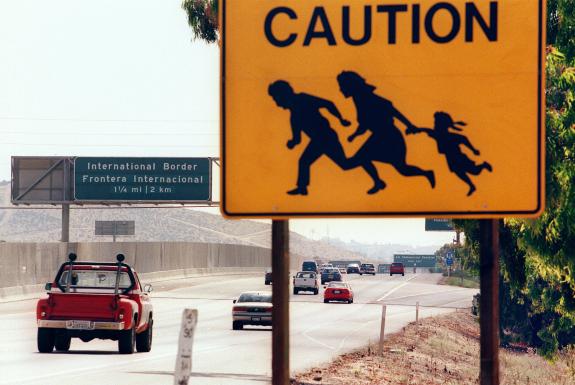
… it’s generally a bit misleading to write about US-Mexico border crossings primarily through a frame of immigration. If you look at this wall on the border near Tijuana, it hardly captures the full scope of the issue to say that this is a barrier to prevent Mexicans from immigrating to the United States and permanently settling there. It’s also a barrier to prevent Americans from walking on the beach into Mexico and buying some tacos. Or to prevent Mexicans from waking walking across the border to sell some beach towels and umbrellas to Americans and then walking back home with pockets full of money. The increasing militarization of the US-Mexico border has tended to increase the duration of time that Mexicans who come to the US to work illegally spend in our country, but both traditionally and under a saner policy most people who cross the border would probably just go back.

People should remember that not only are wage levels higher in the United States, the price level is higher too. Consequently, the best way for Mexicans willing to migrate to maximize their real wealth is to come to the US to work and then take their money back to Mexico. Temporary labor migration of this kind has traditionally been the goal of most work-oriented border crossing and the easiest way to prevent it from turning into illegal labor and semi-permanent settlement is to create a legal channel.

None of this per se answers the terminological issue, but it’s just to gesture in the direction of the idea that we should try to get more specific about what it is we’re talking about. There are laws governing crossing the border, laws governing employment, laws governing citizenship, etc. When I was camping and paddling down the St Croix River, I crossed the US-Canada border without authorization a number of times and probably broke some kind of laws but I was never an “illegal immigrant to Canada,” I was a kid on a canoe trip.
The politics pertaining to the U.S.-Mexican border is based more and more on hysteria and the resources thrown at trying to block movement back and forth between the two nations seems way out of proportion to any real problem free movement creates. Countries have every right to control their borders but when common people are prohibited from legally crossing a line on the map to work then they will start crossing borders at any point they can, they will be forced to live outside the law, and they won’t leave because of the difficulty of returning at a future date. Sometimes government policies play a role in aggravating the very problems they were created to resolve. There really is such a thing as the self-fulfilling prophecy.

Yglesias is right – terminology and definitions are important. (I remember a college professor who continually reminded us during class debates to “define your terms.”) So is the problem that people cross the southern U.S. border looking for work without going through the formal process of applying for citizenship or some sort of work permit?

Maybe rather than trying to recreate the border between North and South Korea with walls, barbed-wire, and armed personnel we should establish centers on the border where those seeking employment in the U.S. can go to apply for and receive the necessary work permits in an expedited manner. If the problem is defined as Mexicans entering the country illegally and never leaving then it makes more sense to make it easy to enter legally and to leave easily without fear of not being able to return.

Thursday, September 30, 2010

With TARP so unpopular how will Americans deal with the next financial crisis?

Jeremy Hobson of public radio’s Marketplace program looks back on the Troubled Asset Relief Program (TARP) and its unpopularity despite success at stabilizing American banks and preventing the unemployment situation from becoming worse.
Let's go back to Sept. 24, 2008.

Then-President George W. Bush: Good evening. This is an extraordinary period for America's economy.

The nation's largest banks were failing. AIG, Fannie Mae and Freddie Mac had been seized by the federal government. The stock market was on the fritz and credit was drying up. All because the mortgages, or troubled assets, being held by banks were losing value fast.

President George W. Bush addressed the nation from the White House.

Bush: Our entire economy is in danger. So I propose that the federal government reduce the risk posed by these troubled assets and supply urgently needed money, so banks and other financial institutions can avoid collapse and resume lending.

The original plan for TARP was to buy those toxic mortgages from the banks so they'd have nice clean balance sheets and could operate normally. In the midst of a presidential election, though, members of both parties were uneasy about the plan.

Jonathan Alter is the author of the new political book "The Promise."

Jonathan Alter: Barack Obama told me in an interview that he knew that it would be toxic politically for him to back the TARP bailouts, but he also knew that it was necessary to prevent a depression.

Even the House Republican Leader John Boehner, who now decries TARP, pleaded with his members to vote for it.

John Boehner: If I didn't think we were on the brink of an economic disaster, it would be the easiest thing in the world to me to say no to this. But I believe the risk in not acting is much higher than the risk in acting.

But Congress wasn't swayed, and voted TARP down at first. By the time a package was passed, buying up mortgages would have been too time-consuming. So the government decided to temporarily pump money directly into the banks.

And Mark Zandi of Moody's Analytics says that turned out to be a slam-dunk success.

Mark Zandi: The banking system stabilized. If it had not gotten that equity, it would have collapsed and taken the economy with it. We'd be in a measurably worse place.

Zandi, who advised John McCain in 2008, has actually done the measurements. He did a study with a former Clinton Administration economist on where we'd be without TARP. It found there would be 8.5 million fewer jobs than there are now and the unemployment rate would exceed 15 percent.

Zandi: By bailing them out, we bailed ourselves out.

And Zandi says we're likely to make money on the bank bailout part of TARP. As for the parts of TARP that have nothing to do with Wall Street? Well, there were about $80 billion in loans to the auto industry. It's not clear if that will be repaid in full. And about $45 billion is slated for assistance to home owners to modify loans and prevent foreclosures.

As Mark Zandi says:

Zandi: That money is gone. We won't get that money back and we'll lose money on that.

Bottom line, out of the all the money initially made available for TARP, only about $475 billion were used. And the Congressional Budget Office expects we'll get all but $66 billion back. But maybe that's not the whole story.

Kenneth Troske is a University of Kentucky economist who sits on the congressional panel that oversees TARP. He says looking at the TARP in isolation ignores other emergency actions by the Treasury and by the Fed that made it easier for banks to repay their loans.

Kenneth Troske: If you take a very narrow view of TARP, and say "Hey, we made our money back," well a lot of the cost of tarp were shifted to other programs that have received much less attention and much less government oversight.

Still, Troske says that TARP did save our banking system. And that's why he worries for the future. Since TARP has become so unpopular, he says:

Troske: In the next financial crisis, and I do believe that there will be a next financial crisis, we will not see another TARP. And if you felt that that was a valuable way to stem a financial crisis, we've lost that policy instrument.

Though it looks like it will be front and center for the next month, since government bailouts are about the most popular thing to run against.