Tuesday, February 20, 2007

Underestimating Al Qaeda again

The war in Afghanistan, against the people responsible for the 9/11 attacks, has been put on the back burner. While the Bush administration is focusing on trying to undo four years of bungling in Iraq that helped push that country into civil war, Al Qaeda has been regrouping in Pakistan and expanding their influence in North Africa.

It is perilous to fail to address these developments.

Bruce Hoffman has this assessment in the L.A. Times:
'AL QAEDA," President Bush declared confidently in October, "is on the run." The extremists, he said, had "played their hand." The masterminds of the organization had been "brought to justice."

But just as we underestimated Al Qaeda before 9/11, we risk making the same mistake now. Although Al Qaeda is often spoken of as if it is in retreat — a broken and beaten organization incapable of mounting attacks, its leadership cut off, living in caves somewhere in remotest Waziristan — the truth is that the organization is not on the run but on the march. It has regrouped and reorganized from the setbacks it suffered during the initial phases of the global war on terrorism and is marshaling its forces to continue the epic struggle begun more than 10 years ago.

Rather than being degraded to the point that it can threaten only softer, more accessible targets like hotels and mass transit, Al Qaeda is very much sticking with its classic playbook of simultaneous, spectacular strikes against even hardened objectives. In other words, we have more to fear from this resilient organization, not less.

****
Rather than "Al Qaeda R.I.P.," we face an Al Qaeda that has risen from the grave. It has been able to adapt and adjust to the changes imposed on its operations by the U.S.-led war on terrorism and reestablish its command and control over international terrorism from the sanctuary it has established in Pakistan's North Waziristan.

Just last month, this alarming development produced a dramatic reversal in the Bush administration's public assessment of the Al Qaeda threat. In contrast to long-standing White House claims, the annual threat assessment presented by outgoing National Intelligence Director John D. Negroponte to the Senate Select Committee on Intelligence painted a disquieting picture of a highly resilient terrorist movement that, he said, is cultivating stronger operational connections to affiliates throughout the Middle East, North Africa and Europe.

Al Qaeda's stunning resurrection, before the very eyes of American military forces stationed across the border in southern Afghanistan, begs the question of how the most powerful country in the world can launch a six-year, no-holds-barred, global war on terrorism — at great cost to its pocketbook and international standing — only to find the main target of these Herculean efforts still alive and kicking.

In retrospect, it appears that Iraq blinded us to the possibility of an Al Qaeda renaissance. The United States' entanglement there has consumed the attention and resources of our country's military and intelligence communities — at precisely the time that Osama bin Laden and other senior Al Qaeda commanders were in their most desperate straits and stood to benefit most from this distraction. What's more, even as we took solace in the president's argument that we were "fighting terrorists over there, so that we don't have to fight them here," Al Qaeda was regrouping.

Pakistan is both the problem and the solution to the most salient terrorist threat still directed against us. Al Qaeda and its Taliban allies could not function without the passive connivance of Pakistani authorities. Moreover, agreements concluded over the past two years between President Pervez Musharraf and the restive tribes along the Afghan border have assured Al Qaeda the noninterference with its activities that enables it to thrive. At the same time, the pivotal role played by Pakistan in the disruption of major attacks and the arrests of low-level plotters shows how dependent the U.S. remains on even this partial cooperation.

Defeating Al Qaeda requires, foremost, that our assessments and analyses be anchored firmly to sound, empirical judgment and not blinded by conjecture and wishful thinking. Second, we need to refocus our attention and efforts on Pakistan and Afghanistan, where, in the months after 9/11, Al Qaeda was indeed on the run. Third, Al Qaeda cannot be defeated by military means alone because it relies on propaganda and radicalization.

Accordingly, the U.S. needs a strategy that better combines the tactical elements of systematically destroying and weakening Al Qaeda's capabilities alongside the equally critical imperatives of countering the resonance of that movement's message and breaking the cycle of terrorist recruitment and replenishment that has both sustained and replenished Al Qaeda.

Monday, February 19, 2007

U.S. contingency plans on attacking Iran

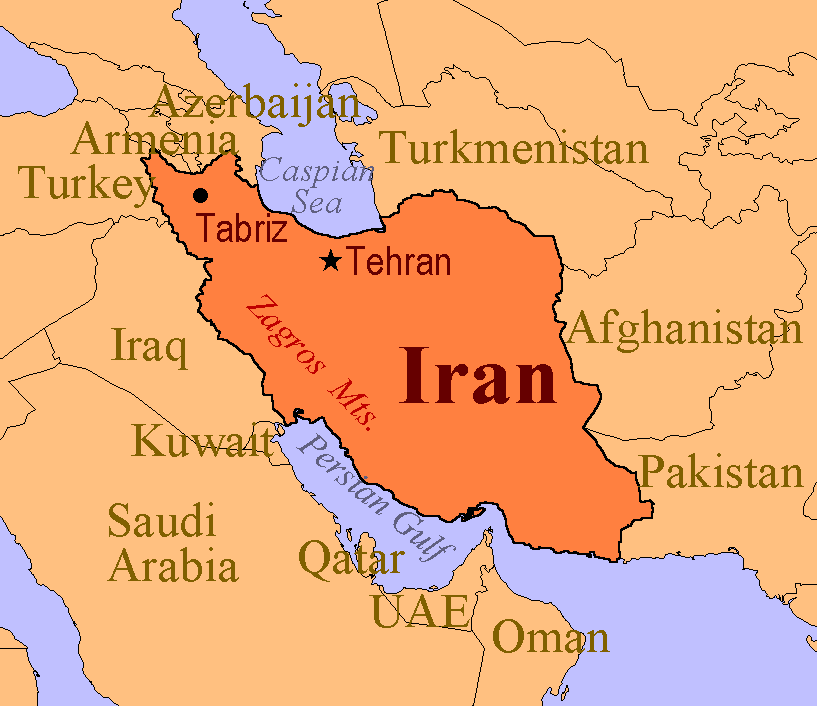
It is no secret that the Bush administration has been itching for a war with Iran. Now, according to the BBC, the United States has established two triggers for an attack on Iran: the development of a nuclear weapon or an attack on U.S. forces in Iraq producing significant casualties that can be traced back to Tehran. U.S. air strikes would go beyond nuclear facilities and include a wide range of military sites.

This form the BBC:
US contingency plans for air strikes on Iran extend beyond nuclear sites and include most of the country's military infrastructure, the BBC has learned.

It is understood that any such attack - if ordered - would target Iranian air bases, naval bases, missile facilities and command-and-control centres.

The US insists it is not planning to attack, and is trying to persuade Tehran to stop uranium enrichment.

The UN has urged Iran to stop the programme or face economic sanctions.

But diplomatic sources have told the BBC that as a fallback plan, senior officials at Central Command in Florida have already selected their target sets inside Iran.

That list includes Iran's uranium enrichment plant at Natanz. Facilities at Isfahan, Arak and Bushehr are also on the target list, the sources say.

BBC security correspondent Frank Gardner says the trigger for such an attack reportedly includes any confirmation that Iran was developing a nuclear weapon - which it denies.

Alternatively, our correspondent adds, a high-casualty attack on US forces in neighbouring Iraq could also trigger a bombing campaign if it were traced directly back to Tehran.

Long range B2 stealth bombers would drop so-called "bunker-busting" bombs in an effort to penetrate the Natanz site, which is buried some 25m (27 yards) underground.

The BBC's Tehran correspondent France Harrison says the news that there are now two possible triggers for an attack is a concern to Iranians.

Authorities insist there is no cause for alarm but ordinary people are now becoming a little worried, she says.
You can read the entire article here.

Inside Iraq raises the question (via American Footprints) as to which side we can expect the Iraqi government to take if war breaks out between the U.S. and Iran. As the blog points out, a significant number of the members of the ruling government in Iraq spent many years in exile in Iran and prefer Persian over Arabic. However, as pointed out here before, there is a strong streak of Iraqi nationalism that will resist Iranian influence. So which way would they go? Given the volatile situation in Iraq right now it might be wise not to force the issue if that can be avoided.

Sunday, February 18, 2007

Causal links between lack of democracy and terrorism: Tunisia

The bungling around in the Middle East by the Bush administration has given democracy promotion a bad name. Yet, despite Bush there is still reason to temper foreign policy realism with a pro-democratic bias. In fact, as argued below, these two approaches are not necessarily contradictory.

Shadi Hamid, at Democracy Arsenal, believes there it is in U.S. interest to promote democracy abroad. He states,
… when people go on and on about how unrealistic it is to make democracy promotion the organizing principle of US foreign policy, they forget that the existence of autocracy abroad is not just a profound threat to our founding ideals, but also to our vital national security interests (so, yes, you can be both a realist and a believer in democracy promotion). It’s actually a very simple concept: autocracy breeds radicalism and terror, and there's a vast literature which makes precisely this point.
He cites a piece by Anne Applebaum in the Washington Post a few days ago about the growing appeal of extremist Islam under the authoritarian regime ruling Tunisia. As she points out the French government is quite willing to tolerate the human rights abuses of the Tunisian regime in the belief it prevents immigration to their country. She asks the same questions raised by Mokhtar Trifi, president of the Tunisian League for the Defense of Human Rights, about the West ignoring the generally pro-Western Arab population.
The Tunisians have also become masters of a kind of recognizable, Putinesque, postmodern political charade, supporting a whole panoply of phony political parties, phony human rights groups, phony elections. They talk of "democracy" and "reform" and of course "anti-terrorism." But break the mold in Tunisia -- engage in genuine opposition politics -- and you might find you've lost your state health care or even your private-sector job. The tentacles of the party reach deep, though actual violence is rare. Says Trifi, "It causes too much trouble." After all, violence could damage the benevolent image that draws so many European tourists to Tunisia's beaches.
In the short term, this system has suited lots of people, not merely the president's friends and relations. Most notably, it has suited France, Tunisia's closest business partner and former colonial power. In 2003, French President Jacques Chirac proclaimed that since "the most important human rights are the rights to be fed, to have health, to be educated and to be housed," Tunisia's human rights record is "very advanced." More to the point, the French believe that the authoritarian Tunisian government is the only thing preventing a massive wave of illegal immigration to their country.
Unfortunately, the authoritarian government is also producing the potential émigrés, too: For the most notable product of the Tunisian "economic miracle" is, at the moment, a lot of well-educated but unemployed young people. Once upon a time, the educated and the frustrated might have formed the backbone of a democratic revolution, just as they once did in South America and Eastern Europe. Now, Tunisians look at Iraq and see that "freedom" brings chaos and violence. Which leaves them with two options: emigration -- or radical Islam. Or perhaps both.
No one knows the true extent of radicalism in Tunisia because it is in the government's interests to exaggerate the threat. Nor does anyone know the true extent of Tunisian radicalism in the suburbs of Paris. But there have been bombs, arrests and reports of al-Qaeda copycat groups. Thus has an apparently benign authoritarianism produced in liberal Tunisia, as everywhere else in the Arab world, precisely the sort of terrorist inclinations it was supposed to prevent.
So why didn't the West interest itself in Tunisian democracy 15 years ago, back before "democracy" became a negative term, back before the not-quite-free economy went sour, back before radical Islam became chic among the blue-jeaned teenagers? The answers, as Trifi knows well, are clear: Because democracy promotion was an afterthought, never an important American goal in the Middle East. Because France, which has far more influence in Tunisia than we do, has never been remotely interested. And because no one in the West has ever been very good at thinking through what the longer-term results of the authoritarian status quo might really be.
You can read her entire piece here.

Saturday, February 17, 2007

Looking the other way as Guinea deteriorates

The situation in Guinea is deteriorating as the population is rising up against miserable living conditions and the almost quarter-century dictatorship of Lasana Conté. Conté has ruled the West African country since seizing power in 1984 and is seen as largely responsible for corruption and the widespread poverty in this country otherwise rich in natural resources.

Unions have called for a general strike and Conté has given the army wide powers to crush the rebellion. In the meantime, the world community does nothing.

This from Eric A. Witte and Kurt Bassuener in the International Herald Tribune:
As Western leaders sit on their hands, Guinea's authoritian president, Lansana Conté, is going in for the kill, crushing street protests as he tries to stifle his country's brave voices for democracy. Since he declared martial law on Monday, scores of people have been killed in violent clashes between protesters and security forces.

The United Nations, the United States, the European Union and the African Union must act quickly to prevent more bloodshed and keep the unrest from spreading to Guinea's fragile neighbors, Liberia, Sierra Leone and Ivory Coast.

Since seizing power in a coup 23 years ago, Conté has sought a veneer of legitimacy through successive fraudulent elections. He runs perhaps one of the more efficient police states in sub-Saharan Africa, financed by the export of bauxite — much of it to North America. Now the aging Conté is ailing, and one way or another, his tenure will soon end.

Fed up with corruption and cronyism, and hoping to present an alternative succession scenario to the widely expected military takeover, Guinea's labor unions took to the streets in January. Tens of thousands marched to demand Conté's resignation and a voice in their government. Conté's troops opened fire, killing around 90. The dictator took to the airwaves, explaining: "Those who want power must wait their turn. It is God who gives power and when he gives it to someone, everyone must stand behind him."

Yet as protests continue, Conté has offered concessions. The unions wanted greater strides for democracy, but, without foreign support, they accepted a deal in which Conté would appoint a consensus prime minister to take over as head of government.

As bad as this agreement was — it left Conté in control of the military and police — the United States and European Union offered only formulaic, low-level expressions of hope that the political crisis could be overcome. Contrast that reticence with their reactions to other "people power" movements, such as those in Ukraine and Lebanon.

Last week Conté reneged on the deal by appointing one of his cronies as prime minister, then unleashed his security forces on protesters. The death toll could climb much higher as rioting youths lose patience and martial law gives the military a green light for repression.

Western governments have long expected the military to step in once Conté steps down. If military leaders perceive that Conté can no longer maintain control, they may take over sooner. But a military regime would be unlikely to bring stability; its leadership and other Guinean elites are riven along ethnic and clan divides that could deepen precipitously in a post-Conté power struggle.

At stake is not just the stability of Guinea, but that of its fragile neighbors, whose recent wars were intertwined with events in Guinea. The last thing needed by Liberia's new democratic president is instability to her north. Sierra Leone is also struggling to overcome the legacy of its civil war, and ethnic tension has been on the rise ahead of July elections. Washington, London, and Brussels have invested heavily in the reconstruction of both. Their passivity in the face of Guinea's destabilization is difficult to fathom.

What would support for democracy in Guinea look like? The European Union, which resumed aid to Guinea in December, would suspend assistance until Conté agrees to step down. Western democracies would back efforts by the Economic Community of West African States and the African Union to mediate his departure. To prevent the rise of a new military regime, Western democracies would announce that such a government would gain neither recognition nor aid. They would channel new funds to Guinea's unions and rights organizations.

Fear of judicial accountability helped ensure the peacefulness of Ukraine's Orange Revolution two years ago. To deter more violence by security forces, the world's democracies would begin contingency planning for a tribunal to hold accountable those responsible for violence.

The United States forged military links with Conté in the late 1990s against threats from the former Liberian president, Charles Taylor, in Sierra Leone and Liberia; Washington has a special responsibility to send these messages to Guinea's military.

A provisional government with international assistance could develop a free and fair election process. At that point, Guineans could finally control their own destiny.

Friday, February 16, 2007

Genocide in Chad

The genocide of Darfur is spilling over the border into Chad as the Janjaweed pursue refugees. Without an international force to protect the refugees there is no one to stop from the Janjaweed. According to the BBC report below, Chad has the same ethnic make-up of nomadic Arab groups and black African farmers and may be prone to the same ethnic warfare.

This from the BBC:
The violence in Chad could turn into a genocide similar to that in Rwanda in 1994, the UN refugee agency has warned.

The UNHCR says the killing tactics from neighbouring Darfur in Sudan have been transported to eastern Chad in full.

***
More than 200,000 people have been killed and 2.5m displaced since war broke out in Darfur four years ago.

Concern is now growing for the 200,000 refugees who sought shelter in eastern Chad.

The conflict in Darfur has followed them across the border with attacks by Janjaweed Arab militia on camels and horseback leaving hundreds dead and 110,000 people homeless.

The BBC's Orla Guerin in eastern Chad says at first, the Janjaweed came from Sudan; later, locals joined in - neighbour killing neighbour.

"We are seeing elements that closely resemble what we saw in Rwanda in the genocide in 1994 and I think we have an opportunity here to avoid such a tragedy from occurring again," UNHCR's Matthew Conway said.

***
Eastern Chad and Darfur have a similar ethnic make-up, with nomadic Arab groups and black African farmers both seeking access to land and scarce water points.

Our reporter says the violence in Chad follows the same pattern as in Darfur - mostly Arabs on camels and horseback attacking non-Arab villages.

Without an international protection force, there is no-one to stop the Janjaweed, she says. In recent days, our reporter followed the trail of the Janjaweed through the ghost villages of eastern Chad, finding torched huts and smashed pots.

She met some of their victims, including a young man stabbed in both eyes and a frail old woman, badly beaten when she dared to look for food.

The UN Security Council is preparing to discuss proposals to send a peacekeeping force to Chad but a decision is not expected immediately.
In the meantime, the world community snoozes. Read the entire BBC piece here.

Making the case for war by innuendo

The Bush administration’s saber-rattling on the subject of Iran has an eerie familiar sound to it: Significant conclusions with potentially dire consequences drawn from scraps of evidence originating from unknown sources and provided to the American media via off-the-record background briefings. In other words, taking the first steps towards war by the use of innuendo. It was five years ago that stories in the media were popping linking the then government of Iraq with al-Qaeda to stoke the pro-war sentiments in the United States and the international community. Of course, the links turned out to be fabrications and the opportunies for al-Qaeda in Iraq came later in the chaos resulting from the bungled war and reconstruction by U.S. forces.

Administration officials have been making a big deal of explosive devices found in Iraq that allegedly originated in Iran. The insinuation is these are somehow provided on orders of the highest levels of the Iranian government with the exclusive purpose of targeting American troops. Despite this administration’s very poor record in successfully fighting wars, it is no secret that many in this administration are itching for a third war in the Middle East -- this time against Iran.

Spencer Ackerman explains in today’s Guardian:
… three facts emerged: Iranian-made weaponry had been discovered in Iraq; this weaponry had been used in attacks on US troops there; and operatives of Iran's Quds Force, a branch of the Iranian Revolutionary Guard Corps, had smuggled the weapons in.

Beyond those three facts lies the real question: whether or not the Iranian regime had approved the smuggling to deliberately attack US forces in Iraq. And, to that question, the administration didn't present a direct answer. One of the briefers said that the Quds smuggling occurred with the support of the "highest levels of the Iranian government." But within days, intelligence officials frantically attempted to walk back on the statement, explaining that the briefer misspoke. The official Iranian policy remains completely unclear - as does US intelligence's actual assessment of it.

That's understandable, since, in the absence of actual evidence, competing interpretations are available. Most attacks that US officials describe have occurred at the hands of the Sunni insurgency. Yet officials at the briefing asserted that the weapons were going to Shia militias - raising the prospect that Iran is seeking instead to arm its Shia Iraqi allies, and some of its weaponry has found its way into the hands of Sunni insurgents through Iraq's thriving blackmarket arms trade. I asked officials at US Central Command to explain where in Iraq attacks on US forces featuring Iranian-made weapons has occurred - Sunni, Shia or mixed areas, in other words - in order to get some sense of who was carrying out the attacks, or a clue as to whether Iran's allies or enemies are using Iranian weapons. It probably won't come as a surprise that the military hasn't responded to my question.

None of this uncertainty has stopped the Bush administration from suggesting... well, something. Speaking on Wednesday, Nicholas Burns, the number three official at the State Department, generically declared that the Quds Force "is a major part of the Iranian government. Therefore, the actions of that force are the responsibility of that government." White House spokesman Tony Snow angrily chastised the press for not focusing on the "central fact" that weapons from Iran are being used on US troops. For his part, President Bush said he was agnostic as to whether or not the Iranian government meant to attack US troops - "which is worse?" he asked rhetorically in a press conference - but as far as he's concerned, the Iranians are doing... something bad.

If this sounds familiar, it should. Before the Iraq war, administration officials spoke in generic terms about how they knew members of al-Qaeda were "in Baghdad." By this artful formulation, they accomplished two important goals: first, they let the American public to draw the conclusion that Saddam Hussein and bin Laden were actively allied; and second, they did so without making an explicit and disprovable claim. During the build-up to the war, CIA Director George Tenet occasionally warned the White House to remove elements of specificity in its statements, in order to insulate President Bush from becoming a "fact witness." Innuendo was far more valuable. It allowed the White House to portray its critics as shortsighted and irresponsibly cautious - obsessed with one complexity or another when the broader picture was so clear and so dire.

Only it wasn't clear at all - and, it turned out, also wasn't so dire Now, with Iran, the administration is reshaping the picture. Yet it can't seem to learn its lesson. Bush won't solve his credibility problem by restricting the specificity of the facts at hand. He'll solve it by jettisoning his innuendo and making statements that actually comport with those facts. That, however, would mean abandoning a strategy that's worked for him very well in the past.

Monday, February 12, 2007

Happy birthday, Charles Darwin

Today is the 198th birthday of Charles Darwin. Mr. Darwin’s theory of natural selection not only helped explain the phenomena of evolution but also popularized the concept in the public imagination.

However, certain Christians have never felt comfortable with explanations of the creation of life than seem to contradict the Book of Genesis. They have devised so-called alternative theories such as Intelligent Design (a.k.a., I.D.) that explains evolution as a series of changes controlled by a supernatural being. They have pushed hard to have this taught in public schools as a legitimate scientific theory. The proponents of the I.D. scheme have been challenged in school boards and in the courts.

While I.D. seems to be fading it is only likely there will be another effort to dismiss evolution and prohibit or inhibit its teaching.

Edward Hume visited the trial in Harrisburg, Pennsylvania during 2005 in the case of whether or not the teaching of Intelligent Design in public school science classes overstepped the constitutional boundaries prohibiting the state indoctrination of religion. He shares these thoughts of his realization there are two interpretations of Darwin’s writings:
… There are really two theories of evolution. There is the genuine scientific theory, and there is the talk-radio pretend version, designed not to enlighten but to deceive and enrage.

The talk-radio version had a packed town hall up in arms at the "Why Evolution Is Stupid" lecture. In this version of the theory, scientists supposedly believe that all life is accidental, a random crash of molecules that magically produced flowers, horses and humans — a scenario as unlikely as a tornado in a junkyard assembling a 747. Humans come from monkeys in this theory, just popping into existence one day. The evidence against Darwin is overwhelming, the purveyors of talk-radio evolution rail, yet scientists embrace his ideas because they want to promote atheism.

These are just a few highlights of the awful and pervasive straw-man image of evolution that pundits harp about in books and editorials and, yes, on talk radio, and this cartoon version really is stupid. No wonder most Americans reject evolution in poll after poll.

But then there is the real theory of evolution, the one that was on display in that Harrisburg courtroom, for which there is overwhelming evidence in labs, fossils, computer simulations and DNA studies. Most Americans have not heard of it. Teachers give it short shrift in schools because the subject upsets too many parents who only know the talk-radio version. But real evolution isn't random; it doesn't say man came from monkeys. Those claims are made up by critics to get people riled up — paving the way for pleasing alternatives like intelligent design.

Real evolutionary theory explains how life forms change across generations by passing on helpful traits to their offspring; a process that, after millions of years, gradually transforms one species into another. This does not happen randomly but through nature's tendency to reward the most successful organisms and to kill the rest. This is why germs grow resistant to antibiotics and why some turtles are sea animals and others survive quite nicely in the desert, and why dinosaurs — and more than 99% of all other species that have ever lived on Earth — are extinct.

The environment changes. The recipe for survival changes with it. And life changes to keep up — or it dies. Darwin's signature insight is both brilliant and elegantly, brutally simple.

The real theory of evolution does not try to explain how life originated — that remains a mystery. The truth is that many scientists accept evolution and believe in God — and in a natural world so complete that it strives toward perfection all on its own, without need of a supernatural designer to keep it going.

The judge in Pennsylvania eventually found that real evolution was not stupid; that intelligent design was religion, not science, and that the school board in Dover, Pa., whose actions had precipitated this replay of Scopes, was out of line. Judge John E. Jones III was rewarded for his sensible and well-documented ruling with death threats. Such is the power of talk-radio evolution.

Meanwhile, a creationist history of the Grand Canyon is on sale in national park shops. A major American museum expressed interest in having me speak about my new book but decided the subject of evolution was too "political" right now to risk it. And teachers across the nation tell me they feel compelled to downplay or skip evolution lessons to avoid controversy; one L.A.-area high school instructor said she is the only one of five science teachers on her faculty to even mention evolution in class, notwithstanding a clear state mandate to teach it.
Happy birthday, Charles Darwin.

Friday, February 09, 2007

Supporting the troops…whatever that means

Does “supporting the troops,” mean endorsing President Bush’s Iraq policy? Or, does it mean keeping them out of harm’s way?

The answer to both is NO. Both are non-arguments. The duty of our professional armed forces is to pursue objectives, frequently in conflict and dangerous, of policies determined by an elected civilian government. Whether or not the policy is wise is a different question. Nor are our troops children in need of protection – this is a professional army of men and women who have volunteered for service that is potentially dangerous.

Rosa Brooks has these sensible comments in today’s L.A. Times:
…To some on the left, "supporting the troops" has come to mean "protecting the troops": keeping them out of harm's way, ensuring that they have the support services they need and generally avoiding sending them to places where they might get hurt — such as, well, Iraq.

But the military isn't a social welfare program, and the troops aren't children. Americans in uniform chose to join the military. Money and educational opportunities may have been added incentives, but it's patronizing to assume that the troops somehow got tricked into their dangerous jobs. If we support the troops, we need to respect their willingness to risk their lives on our behalf.

This means that "protecting" the troops should not be our top goal. We should never needlessly send them into harm's way, and we should give them the resources they need. But when force is necessary — and sometimes it is — we shouldn't shrink from calling on the troops to do the dangerous work they volunteered to do.

Meanwhile, for many on the right, "supporting" the troops has become synonymous with supporting the Bush administration's Iraq policies. It should go without saying that there is no necessary connection between supporting the troops and supporting the war, but let's say it anyway. Plenty of serious and patriotic people — some of whom are in the military — believe that the administration's Iraq policies undermine our national security interests. Sending U.S. troops to sacrifice their lives in pursuit of foolish policies isn't "supporting" them, and shifting course doesn't make lives already lost "wasted."

For the many Americans who simply don't know what to think about Iraq, "supporting the troops" often ends up meaning, by default, that we should just do "whatever the troops think we should do." But that's also silly. For one thing, "the troops" and their viewpoints are pretty diverse. For another, wearing a uniform doesn't magically transform a young American into an expert on geopolitics or national security.

But regardless of our views on Iraq, those of us in civilian life do have unique obligations to those who serve in the military. The troops aren't the only people who take risks in the public service, but police officers or firefighters who can't take the heat — or who disagree with their department's strategic priorities — can quit, while members of the military face prison if they exercise that option. U.S. troops aren't just "serving" their country; they're indentured servants to their country. And in a democracy, our votes sustain the system of laws that bind members of the military.

That's why civilians have a duty to support the troops in the most important way of all: by refusing to let them become pawns in a cynical political game.

Financing our enemies at the gas pump

Given the links between the events of September 11th and Saudi oil you would have thought part of the so-call “war on terrorism” would have been a program of drastic energy conservation and the promotion of non-oil fuels. However, given the influence of big oil in general and with the Bush administration in particular it should come as no surprise this obvious reaction was somehow overlooked. Oh, to be sure, there is the usual empty rhetoric concerning dependence on foreign oil but nothing of significance has been done. (Did you ever notice it is always foreign oil they refer to and never just oil?)

Think about it – if President Bush were sincerely worried about the power of Mahmoud Ahmadinejad, Hugo Chavez and Osama Bin Laden then he could have undercut their resources by putting the U.S. on an energy diet and reducing the amount of oil we use. Every time an American fills up a gas tank these gentlemen are a little more powerful. To be sure this would have costs but compared to the expense (and often futile) military adventures we have engaged in energy conservation and the use of non-oil products for fuel looks like a bargain. And, of course, there is that little matter of global warming.

The bottom line is we are funding many of our international political problems with our lifestyles. Johann Hari has this take on the Saudi oil wealth promotion of Wahhabism:
In his eighteenth-century oasis, Mohammed abd-al Wahhab had a dream. He dreamed of an Islam stripped down to a cold list of mechanical rules, strictly enforced, severely upheld. He ordered whippings and beheadings of Muslims to "purify" the faith. He smashed up and burned down the worship-places of the softer, more mystical Muslims all around him. And - his smartest move - he cut a deal. He met with the chief of the desert bandits who lived in the nearby long stretch of sand called Najd - a man named Mohammed Saud - and offered him his allegiance, in return for enforcing his severe new brand of Islam. The Saud ruling family and the Wahhabi doctrine have been locked in a stiff waltz ever since.

More than two centuries later, oil was discovered under the territory of this bandit-king, and billions of dollars began to soak into the Kingdom. True to their ancestor's deal, the House of Saud used this black gold to promote the ideas of Wahhab - no longer merely on their own sands, but across the world. By paying for thousands of schools, mosques and trained imams, they dispersed the ideas of one reactionary little preacher to every continent. It has been a corporate strategy that leaves Ronald McDonald looking like a puffing, obese slouch. Slowly, steadily, they are succeeding in eroding other, gentler forms of Islam. They are globalising Wahhabism - and your petrol purchases are paying for it.

*****
Our governments are not stopping this Wahabbi-Saudi hate machine for a simple reason: as the New York Times writer Thomas Friedman puts it, junkies don't talk back to their dealers. We are addicted to the Saudi oil supply - it lubricates our cars, our planes, our food supply routes. In the face of this hunger, talk of national security or democratic ideals soon sinks into an oily gloop. Until we have built up clean, green alternatives to Middle Eastern oil (and isn't global warming reason enough?), you and I will keep on paying at the petrol pump for this propaganda against us.
You can read his entire article here.

Thursday, February 08, 2007

Is the “surge” strategy setting Iraq up for a Shiite “Day of Death”?

Iraq’s two main Shiite militias, the Badr Brigade and the Mahdi Army, have successfully infiltrated the intelligence services, the police and the army. Their strategy is to lay low and allow the Americans to do their work combating Sunni militias while the Americans feed, train and arm their supporters. This raises very real concerns about the “surge” strategy promoted by the White House. Is this strategy laying the groundwork for Shiite ethnic cleansing of the Sunni population?

Here is Tom Lasseter’s report in the Mercury News:
The U.S. military drive to train and equip Iraq's security forces has unwittingly strengthened anti-American Shiite Muslim cleric Muqtada al-Sadr's Mahdi Army militia, which has been battling to take over much of the capital city as American forces are trying to secure it.

U.S. Army commanders and enlisted men who are patrolling east Baghdad, which is home to more than half the city's population and the front line of al-Sadr's campaign to drive rival Sunni Muslims from their homes and neighborhoods, said al-Sadr's militias had heavily infiltrated the Iraqi police and army units that they've trained and armed.

"Half of them are JAM. They'll wave at us during the day and shoot at us during the night," said 1st Lt. Dan Quinn, a platoon leader in the Army's 1st Infantry Division, using the initials of the militia's Arabic name, Jaish al Mahdi. "People (in America) think it's bad, but that we control the city. That's not the way it is. They control it, and they let us drive around. It's hostile territory."

The Bush administration's plan to secure Baghdad rests on a "surge" of some 17,000 more U.S. troops to the city, many of whom will operate from small bases throughout Baghdad. Those soldiers will work to improve Iraqi security units so that American forces can hand over control of the area and withdraw to the outskirts of the city.

The problem, many soldiers said, is that the approach has been tried before and resulted only in strengthening al-Sadr and his militia.

Amid recurring reports that al-Sadr is telling his militia leaders to stash their arms and, in some cases, leave their neighborhoods during the American push, U.S. soldiers worry that the latest plan could end up handing over those areas to units that are close to al-Sadr's militant Shiite group.

"All the Shiites have to do is tell everyone to lay low, wait for the Americans to leave, then when they leave you have a target list and within a day they'll kill every Sunni leader in the country. It'll be called the `Day of Death' or something like that," said 1st Lt. Alain Etienne, 34, of Brooklyn, N.Y. "They say, `Wait, and we will be victorious.' That's what they preach. And it will be their victory."

Quinn agreed.

"Honestly, within six months of us leaving, the way Iranian clerics run the country behind the scenes, it'll be the same way here with Sadr," said Quinn, 25, of Cleveland. "He already runs our side of the river."

Four senior American military representatives in Baghdad declined requests for comment.

Al-Sadr's success in infiltrating Iraqi security forces says much about the continued inability of American commanders in Iraq to counter the classic insurgent tactic of using popular support to trump superior military firepower. Lacking attack helicopters and other sophisticated weapons, al-Sadr's men have expanded their empire with borrowed trucks and free lunches for militiamen.

After U.S. units pounded al-Sadr's men in August 2004, the cleric apparently decided that instead of facing American tanks, he'd use the Americans' plans to build Iraqi security forces to rebuild his own militia.

So while Iraq's other main Shiite militia, the Badr Brigade, concentrated in 2005 on packing Iraqi intelligence bureaus with high-level officers who could coordinate sectarian assassinations, al-Sadr went after the rank and file.

His recruits began flooding into the Iraqi army and police, receiving training, uniforms and equipment either directly from the U.S. military or from the American-backed Iraqi Defense Ministry.

The infiltration by al-Sadr's men, coupled with his strength in Iraq's parliament after U.S.-backed elections, gave him leeway to operate death squads throughout the capital, according to more than a week of interviews with American soldiers patrolling Baghdad. Some U.S.-trained units carried out sectarian killings themselves, while others, manning checkpoints, allowed militiamen to pass.
You can read the rest of the article here.

Wednesday, February 07, 2007

American troops and the Iraqi civil war

The anti-war forces, including many Democratic candidates for President, keep harping on the fact that no weapons of mass destruction were found and that the country was misled as to the reasons for the war in Iraq. They are certainly right on the first issue and more right than not on the second (there were reasons to at least be suspicious of WMD’s at the time) but the points here have little to do with trying to decide what we need to do in Iraq now.

And if the anti-war side is stuck on the issues of the past the Bush administration has been in complete denial of the reality that the victory in toppling Sadaam Hussein has been completely squandered and the window of opportunity to help establish a democratic and stable Iraq slammed shut quite some time ago. If it had not been the publicity of the rather gloomy conclusions from the bi-partisan Baker-Hamilton Commission it is quite likely this administration would still be carrying on as if nothing has changed. As it is, they have finally acknowledged things are not going well but seem to believe that a few changes in personnel and a few additional troops in Baghdad will turn the situation around in a few months that has been unraveling for the past four years.

It is becoming clearer each day that American troops in Iraq are less and less fighting an insurgency by Baathists trying to topple a democratic government than they are participating in a civil war being fought along ethnic lines. We are training and arming an army and police of which significant segments are loyal to interests other than the democratic state of Iraq. There are voices in our country advocating taking sides with the Shiite forces. This ignores the fact we have a national interest in being able to sit down with both Sunnis and Shiites throughout the region as well as the moral issue of taking sides mean American troops inadvertently become accessories to ethnic cleansing by helping crush the Sunni militias.

There is nothing that was inevitable about this state of affairs. As Peter Beinart pointed out the New Republic a few weeks ago Shiite and Sunni have cooperated for decades but the collapse of the Iraqi state due to the failure to provide basic security has left the population with no choice but to seek protection from the various militias responsible for most of the current fighting and ethnic cleansing. As Beinart points out despite all the lofty rhetoric about democracy if there is no state then there is no republic.

So what should we do? Is it possible to mitigate the effects of the civil war? How does the United States pursue legitimate national interests in a region in which we have become discredited?

Edward Luttwak has these recommendations in the New York Times:
…. The total number of American troops in Iraq — even including any surge — is so small, and their linguistic skills so limited, that they have little effect on day-to-day security. Nor have they really protected Iraqis from one another. At most, the presence of American soldiers in any one place merely diverts attacks elsewhere (unless they themselves are attacked, which is a sad way indeed of reducing Iraqi casualties).

Intelligence is to counterinsurgency what firepower is to conventional warfare, and we just do not have it or the capacity to gather information on our own. Thus the sacrifices of our troops on the ground are mostly futile.

Politically, on the other hand, disengagement should actually reduce the violence. American power has been interposed between Arab Sunnis and Arab Shiites. That has relieved the Shiite majority of responsibility to such an extent that many, notably the leaders of the Mahdi Army, feel free to attack the American and British troops who are busy protecting their co-religionist civilians from Sunni insurgents. For many Arab Sunnis, on the other hand, the United States must be the enemy simply because it upholds the majority of the heretical Shiites.

Were the United States to disengage, both Arab Sunnis and Shiites would have to take responsibility for their own security (as the Kurds have doing been all along). Where these three groups are not naturally separated by geography, they would be forced to find ways to stabilize relations with each other. That would most likely involve violence as well as talks, and some forcing of civilians from their homes. But all this is happening already, and there is no saying which ethno-religious group would be most favored by a reduction of the United States footprint. One reason for optimism on that score is that the violence itself has been separating previously mixed populations, reducing motives and opportunities for further attacks. That is how civil wars can burn themselves out.

In any case, it is time for the Iraqis to make their own history.
And Andrew Sullivan follows up on his blog:
Once the decision was made to foment anarchy in Iraq - a decision made with clear foresight by Donald Rumsfeld, George W. Bush and Dick Cheney - the chance of Americans to influence events in a country they don't begin to understand was thrown away. The great delusion of the pathetic rearranging of deck-chairs called "the surge" is that we are somehow supposed to believe that four years after we abandoned control of Iraq, we can regain it with a handful of new troops. We can't. A civil war is underway in Iraq to test the real power of the various factions and sects in the country. There will be no peace until such a rebalancing of power is finished. That will mean, alas, ethnic cleansing, more violence, hideous atrocities and the risk of regional war. So be it. It's already under way under American occupation; the only problem is that young Americans are - ludicrously - supposed to police it.

… the less the U.S. is directly involved in one side or another, the more options we retain for the future. Disengagement, in other words, is defeat. But it is defeat in a war we have already lost. It could mean a gain in a war that is only just beginning. Which could mean victory in the end, whatever victory at this point can be understood to mean.

Tuesday, February 06, 2007

Can nuclear power save the planet?

The human contribution to global warming is finally accepted and the contribution negatively impacting upon our environment is greenhouse gas emissions -- mostly released by burning fossil fuels in power plants, factories and cars. If this trend cannot be reversed or at least halted then the future of life on this planet as we know it may be doomed.

James Lovelock, the inventor of the Gaia theory that has been embraced by environmentalists, is advocating the massive expansion of the use of nuclear energy. He calls for an end to “green romanticism” that supports only unrealistic alternatives to the use of bio-fuels. He argues that however attractive wind and solar power may be, these alternatives cannot come close to provide the world’s electricity needs and time is short to avoid a climate catastrophe.

This from Der Spiegel:
A few days ago, the theoretical physicist Stephen Hawking gave a speech in London in which he said that nuclear war no longer poses the only threat to humanity's very existence. According to Hawking, the dangers posed by climate change are now almost equally as great, and we must do everything that is humanly possible if we are to have any hope of averting them.

When James Lovelock heard about Hawkings' lecture, three hundred and fifty kilometers away at his remote estate near Cornwall, he exclaimed loudly: "Hawking is underestimating the danger."

Lovelock is a chemist, inventor, author and visionary environmental guru. Using a detector he invented himself, he was the first to provide evidence of ozone-consuming fluorochlorohydrocarbons (FCHC) in the atmosphere. More importantly, Lovelock is the inventor of the famous "Gaia hypothosis," which holds that the planet (which he named after the Greek goddess of the Earth, Gaia), constantly controls all of its systems on land, in the water and in the air in such a way as to preserve life -- almost as if the earth itself were a living organism.

Lovelock's fellow scientists were initially appalled by the New Age nature of his theory. But now his ideas have not only become a cornerstone of the environmental movement, but have also acquired a new name: "Earth System Science."

Lovelock's current prognoses for the earth's inhabitants are as gloomy as they are provocative. He is convinced that the 21st century will not be a good one. He claims that climate change caused by human activity will devastate large swaths of the earth, and by the year 2100 there will only be about a billion people left -- and possibly only half as many.

Lovelock is now 87 years old and happy that he will be able to avoid this future -- although he has nine grandchildren. Sometimes he feels like a Roman citizen living around the year 480, watching as an empire meant for eternity fades away, or like a doctor delivering a fatal diagnosis. And at times he probably relishes how he distresses his audiences (he is in demand worldwide as a speaker) in his role as a prophet of doom. "Even a nuclear war," says Lovelock, "would not lead to the level of devastation worldwide that global overheating will cause."

No world power, no scientist, no politician, no consumer forsaking his or her familiar comforts, and neither emissions trading nor wind energy nor biofuels will be capable of preventing the earth's demise, he says. According to Lovelock, it will at best be possible to delay the catastrophe for a while -- primarily through the massive expansion of nuclear energy.

*****
"Our situation," Lovelock says, "is similar to that of a boat that suddenly loses engine power shortly before reaching Niagara Falls. What's the point of trying to repair the engine?" To save what it can, Lovelock believes, the world must embark on a completely different path. Most important, it must abandon the notion of "green romanticism."

Lovelock has nothing but ridicule for environmentalists' favorite issues, such as "sustainable development" and "renewable energy," calling them "well-meaning nonsense." He is convinced that wind and solar energy will never be even remotely capable of meeting worldwide energy needs. In China alone, for example, a new large coal power plant is put into operation every five days, imposing additional burdens on the atmosphere. The only solution, according to Lovelock, is the massive expansion of nuclear energy worldwide.

A reliable supply of electricity, says Lovelock, is the key issue when it comes to survival on a warmer planet. He loses no sleep over the risks of nuclear power.

"Show me the mass graves of Chernobyl," he demands provocatively. No more than a few thousand people died after the 1986 meltdown -- a small price to pay, he says, compared to the millions who could fall victim to CO2. He adds that compact nuclear waste is vastly easier to control than the close to 30 billion tons of CO2 released into the atmosphere each year by the burning of fossil fuels.

"Fanatical Greens" who confuse nuclear power with nuclear bombs, says Lovelock, have discredited this source of energy. Do-gooders, he adds, are concerned about pesticide residues in bananas and the link between mobile phones and cancer, all the while accepting CO2 poisoning as a necessary evil. "They strain out the mosquitoes while blithely swallowing camels," he says.

Lovelock does give his readers at least some reason for optimism. Humankind, he writes, could use the tools of technology to ease its suffering. For example, engineers should develop jet engines that can tolerate traces of sulfur in kerosene. This, according to Lovelock, would be the easiest way to eject sulfur aerosols into the stratosphere, where they would reflect sunlight back into space, thereby helping cool the earth. Giant mirrors positioned in space would be another option.

And yet none of this will prevent the planet's illness from progressing, at least according to Lovelock's diagnosis, which is ultimately fatal.
You can read the entire article here.

Monday, February 05, 2007

American democracy – myth and reality

According to Gary Younge in the Guardian, Americans “hold the principle of democracy dear; but the purpose of democracy remains elusive.” He is right. Americans hold onto a myth of democracy (see Voting + shopping = democracy. Right?) while practicing it only on the margins.

Part of the problem is with the American people who may be inclined to restrict the civil liberties of others they themselves enjoy (see It’s a free country – usually). Of course, civil liberties are the protection of minority rights against the will of the majority that assumes the majority is willing to assert itself. However, if you look at electoral participation, consider the vast numbers of citizens who are otherwise qualified to vote but are not even registered to do so and of those registered the vast numbers who do not vote. It is politically incorrect to say their vote doesn’t count but perhaps there is an element of truth to that assertion.

Much of the problem is structural (see Our problematic US Constitution). The Electoral College system certainly makes the votes of most Americans irrelevant in non-competitive states in Presidential elections. Power is skewed towards voters from small states the way representation is structured for both the U.S. Senate and U.S. House of Representatives. And despite all the talk of the balance of power between the three braches of government, the reality is the executive is head and shoulders above the other two branches in power and that power it growing. Unlike a parliamentary system where the executive is joined to the legislative branch and a vote of no confidence can bring down the government and force an election, the President can carry on policy more or less independent of the wishes of the legislative branch and cannot be removed from office other than the extraordinary act of impeachment.

Right now there is much attention on the various candidates for the U.S. presidency – the election for which is almost two years away. Rather than discussing if America is ready for the first woman president or whether Obama is black enough or why John McCain is no longer a “straight-shooter,” why aren’t we discussing why we have to tolerate the widely unpopular Bush presidency that is doing harm to our country for two more years? Where is the debate about the structural problems with the way we elect our leaders and govern ourselves?

Here are Gary Younge’s thoughts on the matter in today’s Guardian:
Americans, such demanding consumers in every other aspect of their lives, curiously expect little from their political leaders. They hold the principle of democracy dear; but the purpose of democracy remains elusive. The notion that "the people shall govern" is the cornerstone of American political identity - even if the nonchalance with which they watched Bush steal the 2000 election revealed a disturbing reluctance to defend it. Yet the idea that elections should be the mechanism for effecting real change barely seems to register - which is why it was relatively easy for Bush to get away with robbery.

The weekend before November's midterms, for example, I walked up the Las Vegas Strip asking people if they thought the coming elections mattered. Roughly one in five either did not know the elections were taking place or had no intention of voting. Yet precisely 100% said they thought the elections mattered. This dislocation is not particular to the US. For all its inadequacies, America's political culture has proved far more responsive to opposition to the war or corruption than Britain's. But both the popular attachment to democratic ideals and the general ambivalence to democratic outcomes are more intense, making the discrepancy more pronounced.

Everybody knows that, if counted (a significant if), their vote will make a difference to who is actually elected. But few expect that whoever they elect will really make any difference to the issues they care about. And so voting takes on a ritualistic quality. Like Independence Day or Thanksgiving, it marks a date on the calendar not for changing America's politics, but for celebrating its promise.

Whether one participates or not seems less important than the fact of the event itself. The consensus view of November's elections is that voters turned their back on the war and the Bush agenda and opted instead for a new course in favour of bipartisanship and troop withdrawal. But the truth is that most of them turned their back on the elections. The fact that, at only 42%, this was the highest midterm turnout for 36 years is merely an indication of how entrenched this condition has become. The so-called Gingrich revolution of 1994 was won with just 38.8% of the vote. In the words of Gil Scott-Heron: "The first thing I want to say is: mandate, my ass."

The point here is not that there is no difference between the two main parties but that the difference is insufficient to make a significant impact on the lives of large numbers of Americans. The problem is not that people don't want or need change - the poorer you are, the less likely you are to vote - but that they have long since given up on the idea that voting is the way to get it.

The future of the country was supposed to hinge on the outcome of the 2004 presidential election. But somehow the issues of poverty, racism and infrastructural decay that were evident in the aftermath of Hurricane Katrina nine months later just never came up. By the time the midterms arrived, little over a year later, Katrina had somehow become irrelevant again.

It's not difficult to see why. Elections are big business. Last year the parties spent $2bn on ads alone. Throw in the fees for thousands of lobbyists, consultants and fundraisers and the electoral-industrial complex starts to develop a momentum of its own. Hillary Clinton, who faced only token opposition in a Senate race she won by 30 points, still lavished $27,000 on valet parking and $13,000 on flowers. The people who provide this money have healthcare, housing and decent schools for their kids. They pay the pipers and name the tune.

The mainstream media dances dutifully. Reporters somehow never encounter non-voters, instead constructing a country hotly debating the issues and weighing up the candidates. Obsessed by polls and personalities, they have a surreal fixation about who is up and who is down, with little indication of why we should care. They have barely digested the results of one election before they move on to devour the next. The morning after the midterms, with the fate of the Senate in the balance, CNN already had a banner along the bottom of its screen that read "America votes 2008". New York magazine hit the stands with a picture of Hillary Clinton on the cover and the words: "And now the real race begins".

And so in the Washington Hilton the permanent campaign that transforms American politics into a never-ending soap opera continues. Four years ago a rank outsider, Howard Dean, made his name at this event with an anti-war speech that transformed the dynamics of the campaign. This year he wielded the gavel as the leader of the Democratic National Committee and everybody is against the war.

It's almost two years until the presidential elections. We can only hope that between now and then progressive movements will again see the candidates' opportunism as their opportunity and bring their influence to bear on whoever decides to run. In the meantime, with little of substance to debate, the media are reduced to discussing strategy and style. Can the Democrats reclaim the west? Should they abandon the south? When will Obama's star fade? Are Hillary's positives greater than her negatives? Is America ready to elect a Mormon, a black man or a white woman? Enjoying the race, and ignoring what lies beyond the finish line.

Saturday, February 03, 2007

Neglecting Afghanistan

Whether it is opium or terrorists, what comes out of Afghanistan seems to find its way to the United States. With all the attention on whether to “surge” or not in Iraq, the situation in Afghanistan is on a downward spin and not commanding much attention in Washington. Life has become desperate for many particularly women.

The Taliban have made inroads in the countryside and recently overran the town of Musa Oala in the Helmand province. Despite vows to retake the town, the fact that the Taliban is now making successful raids into Afghanistan from their hideaways across the border in Pakistan is a sign of their growing strength and trouble to come. It is time the United States and our NATO allies take a close examination of what we are doing and what should be done in that country.

Robert Fox, in the Guardian, considers the British strategy in light of the lack of resources to fight:
The Taliban capture of the centre of Musa Qala in northern Helmand is the biggest setback to British efforts in Afghanistan since Tony Blair first sent troops there at the end of 2001.

The town, in the opium poppy growing belt along the Helmand river, had been held by British paratroopers in desperate fighting through much of the summer. British forces were spread out in small outposts or "platoon houses" across the province - in the hope they would become small havens of security from which the British and Afghan government force hoped to spread "ink spots" of peace across the province - one of the most violent in all Afghanistan.

Britain has about 5,400 service men and women now in Afghanistan, but of them only 1,000 or so are combat troops. They are served by only seven Chinook transport helicopters and eight Apache AH-64 helicopter gunships to protect them.

With such thin resources, the British stability plan always contained an element of bluff. By mid summer, within a few weeks of the arrival of British forces in Helmand, it was evident that the Taliban were far more numerous, better-armed and prepared than British and Nato intelligence had indicated. It was feared that some of the isolated positions in Sangin, and Now Zad, as well as Musa Qala, might be overrun and their British and Afghan army garrisons slaughtered.

A deal was struck for the Taliban and the British to leave the centre of Musa Qala and the elders and their council to take over. It was discussed and endorsed by President Karzai himself and the senior British commanders, including General David Richards, the British commander of the entire international force ISAF, now some 32,000 strong. This week, as the deal was evidently unravelling, no one wanted take responsibility for it.

All week, relations between the elders and the local Taliban became more fractious. The house of a suspected Taliban leader, Mullah Gaffur, was bombed by an American B1B Lancer bomber, but he escaped and his car was later spotted by a Nato drone, abandoned in a ditch.

On the first day of this month, the Taliban attacked the centre of town but were repulsed by local militia. In the morning, they attacked again, ramming a tractor into the police station and wrecking a large part of it. Compounds and houses were set on fire and hundreds fled fearing a retaliatory air raid by Nato.

Officials at the British command in Helmand admit they had been stunned by the attack. Most will say that, while the Musa Qala deal was not perfect, it showed a way in which local Afghans could take charge of their own security and fend off the Taliban. "We knew we could never carry out a pacification," a senior British commander at Nato told me. "You have to get down and dirty and do these local deals."

Although the Italian and, on occasion, the American troops in southern Afghanistan have successfully cut similar deals for local leaders to stand up against the Taliban, the Americans are dead against the British approach of mild threat and rough diplomacy.

"The Americans are always kinetic about these things - believing in hard force first," said a British general concerned with relations with the Americans. The new American commander who takes charge of the international force in Afghanistan, Isaf, on Sunday, General Dan "Bomber" McNeil has made his disapproval plain to the British. "He describes the Musa Qala deal as a tactical mistake and a strategic disaster," said a Nato source.

Which leaves British strategy and forces in Afghanistan in a bit of a spot. The forces are still under pressure at other isolated centres - virtually under siege in Sangiun, which holds the vital 611 main north-south highway, and at Now Zad, where they are held in a ceasefire by a more robust version of the Musa Qala truce. Royal Marines are involved in a ragged guerrilla campaign around Garmsir, which includes the main drug-smuggling route to Iran, as well as one of the main channels for bringing Taliban recruits from Pakistan.

The British know they do not have the forces or back-up to go on the offensive in a way the new McNeil command of international forces is likely to want. In particular, they are short of support from medium-sized and attack helicopters. The extra resources are not likely to be found while UK forces are so heavily committed in Iraq as well as Afghanistan, and the Treasury is demanding what amounts to a real cut in funding in the current Comprehensive Spending Review. "The trouble is that the government wants to fight two wars with what, in terms of resources and funding, is really a peacetime army," said one senior officer recently.

Friday, February 02, 2007

Human contribution to climate warming

The costs of inaction in mitigating greenhouse gas emissions -- mostly released by burning fossil fuels in power plants, factories and cars -- have became more apparent following the release of a report by the IPCC (Intergovernmental Panel on Climate Change) available at their website here. According to the Washington Post, the report states that Arctic Sea ice will melt by 2100 and that greenhouse gasses are more likely than not making tropical storms more intense. Rising sea levels between 7 and 21 inches will flood low lying areas. The report predicts a rise in temperatures between 3.2 and 7.9 degrees Fahrenheit (1.8 and 4.0 Celsius) in the 21st century. The report notes that the ten hottest years since records began in the 1850’s have occurred since 1994.

According to Achim Steiner , the executive director of the United Nations Environment Program, “The implications of global warming over the coming decades for our industrial economy, water supplies, agriculture, biological diversity and even geopolitics are massive.”

This is particularly important for citizens of the United States, China and India to hear. All three are major polluters and are not participants in the Kyoto Treaty. Under the Kyoto agreement, 35 industrial nations have agreed to cut greenhouse gas emission to 5 percent below 1990 levels by 2012.

This from the BBC:
"We can be very confident that the net effect of human activity since 1750 has been one of warming," co-lead author Dr Susan Soloman told delegates in Paris.

The report, produced by a team tasked with assessing the science of climate change, was intended to be the definitive summary of climatic shifts facing the world in the coming years.

The agency said that it would use stronger language to assess humanity's influence on climatic change than it had previously done.

In 2001, it said that it was "likely" that human activities lay behind the trends observed at various parts of the planet; "likely" in IPCC terminology means between 66% and 90% probability.

Now, the panel concluded that it was at least 90% certain that human emissions of greenhouse gases rather than natural variations are warming the planet's surface.

They projected that temperatures would probably rise by between 1.8C and 4C, though increases as small as 1.1C (2F) or as large as 6.4C (11.5F) were possible.

In 2001, using different methodology, the numbers were 1.4 (2.5F) and 5.8C (10.4F).

On sea level, there has been a more fundamental debate.

Computer models of climate do not generally include water coming into the oceans as ice caps melt. So the IPCC had to decide whether to exclude this from its calculations, or to estimate the effect of a process which scientists do not understand well but which could have a big impact.

They used the former, more conservative approach, projecting an average rise in sea levels globally of between 28 and 43cm. The 2001 report cited a range of nine to 88cm.

As for climate change influencing the intensity of tropical storms in some areas of the world, the IPCC concluded that it was likely - meaning a greater probability than 66% - that rising temperatures were a factor.

Dr Rajendra Pachauri, the IPCC chairman, said: "It is extremely encouraging in that the science has moved on from what was possible in the Third Assessment Report.

"If you see the extent to which human activities are influencing the climate system, the options for mitigating greenhouse gas emissions appear in a different light, because you can see what the costs of inaction are," he told delegates in Paris.

Achim Steiner, executive director of the United Nations Framework Convention on Climate Change (UNFCCC), said the findings marked a historical landmark in the debate about whether humans were affecting the state of the atmosphere.

"It is an unequivocal series of evidence [showing that] fossil fuel burning and land use change are affecting the climate on our planet."

Mr Steiner, whose agency oversees the operation of the Kyoto Treaty, added: "If you are an African child born in 2007, by the time you are 50 years old you may be faced with disease and new levels of drought."

He said that he hoped the IPCC report would galvanise national governments into action.

But a study published on the eve of the IPCC report suggested that the international body's previous reports may have actually been too conservative.

Writing in the journal Science, an international group of scientists concluded that temperatures and sea levels had been rising at or above the maximum rates proposed in the last report, which was published in 2001.

The paper compared the 2001 projections on temperature and sea level change report with what has actually happened.

The models had forecasted a temperature rise between about 0.15C-0.35C (0.27-0.63F) over this period. The actual rise of 0.33C (0.59F) was very close to the top of the IPCC's range.

A more dramatic picture emerged from the sea level comparison. The actual average level, measured by tide gauges and satellites, had risen faster than the intergovernmental panel of scientists predicted it would.

The IPCC's full climate science report will be released later in the year, as will other chapters looking at the probable impacts of climate change, options for adapting to those impacts, and possible routes to reducing emissions of greenhouse gases.

Thursday, February 01, 2007

Delusions about Iraq

Everyone in the immediate White House chain-of-command is making the case for the “surge” in troop strength in Iraq as the cure-all to the growing chaos and civil war in that poor country. The President and especially the Vice President are simply delusional about success so far and success to come.

On the other hand, while many leading Democrats are absolutely correct that the situation in Iraq is a complete mess they may be overly simplistic about the ease of a withdrawal of American troops and somewhat indifferent to our moral obligation to try and mitigate the strife and bloodshed we are in part responsible for.

These are exactly the points made by the editors of the New Republic this week:
… Cheney has repeated his optimistic take on Iraq so often that you can't doubt his belief in it. And, therefore, he properly qualifies as a delusional individual. Now, Cheney may or may not be the most influential man in the White House these days. But his assumptions about Iraq continue to hold sway. Despite their plans for an escalation, administration officials fail to grasp the scale of our problem in Iraq--or its urgency. There's a reason why the plan has virtually no defenders outside the president's chain of command.

For the last week, Cheney and Bush have defended the plan by placing the onus on its critics. "Those who refuse to give this plan a chance to work have an obligation to offer an alternative that has a better chance for success," Bush has argued. This is, to borrow Cheney's phrase, hogwash.

But, OK, here's an alternative: Stop making things worse. It's now clear that the Maliki government is not going to unify the country; it's interested in U.S. participation only to the extent that it can turn our Armed Forces into an instrument of sectarian warfare. Our military must get out of the business of helping Shia death squads--a business in which the surge will only implicate us more deeply.

Does this mean we have no further military role in Iraq? No, it does not. We have a strong interest in staying to fight Al Qaeda, and we have a powerful responsibility to mitigate ethnic slaughter and protect Iraqi refugees as the civil war deepens.

There is, for that reason, something unsettling about Democratic rhetoric at this juncture. While the vast bulk of the Democrats' proposals are reasonable--benchmarks for the Iraqi government, a renewed focus on battling Al Qaeda--some of their speechifying is less than appealing. Hillary Clinton says she "resents" that Bush's successor will inherit his mess; Barack Obama talks about letting Iraqis tackle their own problems; every other presidential candidate decries the continued Iraqi dependency on the United States. They may be right to disdain Bush and his war. But they are also evading America's moral responsibility for the fate of the country we invaded. We set events in motion, and now there are ethnic groups that depend on our protection from catastrophes that will follow our withdrawal. Some of these catastrophes may be inevitable. But that doesn't justify throwing up our hands--or rhetoric that raises public expectations of an easy and guilt-free withdrawal.

The current swirl of binding and nonbinding congressional resolutions is hardly satisfying. But this glut of legislation was born of desperation. The Bush administration continues to push ahead on its course in spite of public opinion, congressional consensus, and bloody reality. These resolutions may be the only vehicles for sending a message to the obstreperous bunch in the White House. And, even when the surge happens, these resolutions could help lay important political groundwork for foisting a new strategy on the White House in the future. Sooner or later, even for Dick Cheney, reality must intrude.

Saber rattling and Iran

As one political observer commented yesterday on the radio the administration wants to distract the public from the disaster in Iraq to Iran, which is not yet a disaster.

Make no mistake about it, Iran, particularly under the leadership of Mahmoud Ahmadinejad, is a problem. The repercussions of Iran’s pursuit of a nuclear program are of concern to the entire international community. Ahmadinejad’s statements about Israel and the recent hosting of a conference of Holocaust-deniers are a clear signal of hostility to the region’s Jewish communities. And whether or not one believes the extent of meddling in Iraq it is accused of by U.S. officials, given its history of use of proxies such as Hezbollah in Lebanon and the proximity of Iraq, it is extremely difficult to believe Iran is not flexing its muscles in the area.

But none of this is really new. What is new is the intensity of the rhetoric coming out of Washington in recent weeks aimed at Iran. As mentioned here before, President Bush and President Ahmadinejad have a common interest with their respective citizenry to play up the threat posed by the other. Of course, a cynic might conclude that the administration is preparing the public for a third war in the region it has already decided to pursue.

The wars in Afghanistan and Iraq are already going poorly and the reasons have little or nothing to do with Iran. Iraqi Prime Minister Malaki has expressed concern about the United States and Iran using Iraq as a battlefield against each other. There is the possibility Iran could play a positive role in both of those conflicts yet this administration eschews diplomacy. Obviously this administration has less interest in winning wars than in fighting them.

Joe Conason has this assessment in today’s New York Observer:
Whatever George W. Bush may tell us about his intentions toward Iran, every action and order indicates that he will seek to expand the war eastward from Iraq. Despite the warnings voiced by wiser military and diplomatic advisors, the President still seems to be listening to the same discredited neoconservatives whose fantasies and falsehoods drove us into the Iraqi quagmire.

If their plotting succeeds in provoking military conflict with Iran, the resulting carnage could indeed make Iraq look like a “cakewalk,” to quote one of the more stupid predictions that preceded the current war.

Imagine firefights erupting along the Persian Gulf and violent uprisings among the Shia masses in the Baghdad slums and southern Iraq—and then imagine the entire region convulsed by ethnic and religious conflict. The potential consequences could be catastrophic, from the closing of the Gulf straits and a new oil crisis to ruptured political alliances and terrible American casualties.

Yet regardless of these risks, the Bush administration’s urge to provoke Iran is as unmistakable as its preparations for a wider war. Nearly every day, the White House sends obvious signals of belligerence to Tehran, with the same drumbeat heard during the months that led up to the invasion of Iraq.

The President announces that he will deploy Patriot batteries to the region, which can only be useful in shooting down Iranian missiles. The President sends another carrier battle group to the Gulf, with an air wing poised to strike Iranian nuclear sites. The President replaces the four-star Army officer running Central Command, the Middle East region, with a Navy admiral whose specialty is naval air combat. The President orders an armed raid on an Iranian diplomatic office in northern Iraq, which nearly results in a shootout with Kurdish troops.

With great fanfare, the President issues a military directive allowing U.S. troops to kill Iranian agents discovered in Iraq, even though those same agents are often guests of the Iraqi government we support. And without a hint of irony, he declares that the Iranians—whose diplomatic relations with Iraq seem more durable than ours—will be held “accountable” for meddling in their neighbor’s internal affairs.

As in the march toward war with Iraq, the justification for military action against Iran is the looming threat supposedly posed by the regime’s pursuit of nuclear weapons. But according to Mohammed ElBaradei—the director of the International Atomic Energy Agency, whose assessment of Iraq’s feeble nuclear program proved correct—the Iranians have no hope of producing an atomic weapon within the next five years. So the rush to war seems premature—and those who now insist otherwise were wrong and dishonest about Saddam Hussein’s phantom arsenal.

If the Bush administration’s policies are meant to diminish the power and influence of Iran, they have been a dismal failure so far. Encouraging Israel to fight a proxy war against Hezbollah in Lebanon, for instance, only increased Iran’s prestige throughout the Middle East, while weakening more moderate Arab regimes, which
rightly fear the aggressive extremism of Iranian President Mahmoud Ahmadinejad.

Is there an alternative to military confrontation with the mullahs? Only three years ago, the predecessors of Mr. Ahmadinejad secretly tried to open negotiations with the United States. According to a recent BBC report, Iranian leaders offered to reduce their support for armed Lebanese and Palestinian militants to help stabilize post-Saddam Iraq, and to open their nuclear program to full inspection; in return, they wanted diplomatic relations and commerce with the United States. But former State Department officials confirm that the White House, under the baneful gaze of Vice President Dick Cheney, spurned that olive branch as an unacceptable compromise with “evil.” (He didn’t consider those Iranians quite so evil back when his foreign subsidiaries at Halliburton were doing lucrative business in Tehran.)

By rejecting Iran’s tentative offer of improved relations, the Bush administration abetted the rise of Mr. Ahmadinejad, a populist and fundamentalist who argued for confrontation instead of compromise with the West. But that policy has entailed severe costs for the Iranian people, who are suffering from inflation and sanctions as well as from fear of war. The Iranians increasingly despise their own government, which faces constant rumors of its own fall.

What sustains Mr. Ahmadinejad against both his own people and world opinion is the prospect of military aggression by the United States. Americans are not the only people who feel the “rally effect” that brings us together in times of external attack. The more we rely on such threats as the basis for U.S. policy, the more we bolster our enemies—and the closer we come to pulling the trigger, with incalculable consequences.
President Bush insists that he has no plans to attack Iran, but of course he promised that war on Iraq would be a last resort. Let’s hope he is telling the truth this time.